About Me

Kuala Lumpur, Malaysia
I am married to my loving husband for more than 45 years now. I am a mother to 3 beautiful children, until years ago when I lost my youngest son. Since then my life is forever altered but yet unbroken....

Monday, 4 November 2019

03 Da Nang: Culture and Heritage in Hoi An Old Town...

"Storms don't come to teach us painful lessons, rather they were meant to wash us clean..." - Shannon L. Alder

(Japanese Bridge at the Heritage Town of Hoi An)

Day 03: Hoi An Old Town and My Khe Beach
03 November 2019


(Another heavy breakfast to start the day)

This morning we started early to visit Hoi An Old City. On the way we made a brief stop at a Marble Shop and Showroom. Here we had the opportunity to watch the making of marble ornaments and shopped for small marble souvenirs.

(Local scenes souvenirs for sale)
(Various colours of marble sculptures)

We reached Hoi An early and visited a Silk Factory before we began our tour of the old city. Hoi An is situated on the coast of central Vietnam and is home to colonial architecture, rich culture, and breath-taking beaches. Visitors are enchanted by the relaxed pace of life and stunning local attractions of Hoi An.

(Silk worm cocoons before processing into silk threads)
(The ladies nimble fingers sewing using silk threads)
(Colourful table cloths and cushion covers)

Every nook and cranny of the UNESCO protected Ancient Town is picturesque. The whole town is somewhat of an outdoor art gallery with centuries-old tea houses painted in a distinctive golden hue. There are lantern-decorated alleyways, quiet canals, colourful bridges, noisy market places and peaceful locals going about their daily life. Cars are not allowed in the old town. Tourists could rent bicycles or ride on the rickshaw to go around the old city.

(A street vendor selling fruits and local delicacies)
(A rickshaw to transport tourists around town)
(An old coffee shop in the old town)
(A coffee shop by the river, full of tourists)

One of the iconic attractions in Ho An is the Japanese Covered Bridge dating back to the 18th century. It was built by the Japanese then residing in Hoi An as a means of getting to the Chinese quarter. It is especially photogenic at night with the reflection of the lights on the water surface.

(The 18th Century Japanese Bridge)
(Hot and sunny weather in Hoi An)

We visited Tan Ky, a Merchant Heritage House Established in the 17th Century. It is one of the most famous architectural buildings in Hoi An, blending Japanese, Chinese architectural styles. The house has been the home for the family for seven generations.

(One of the Heritage House in town)
(The long history of Tan Ky House)
(A typical souvenir shop in Hoi An)
(A colourful decorated bistro)
(Only rickshaws and bicycles are allowed in Hoi An)

The Thu Bon River runs through the Ancient Town. During the day, the river is busy with fishing boats and cruise boats ferrying locals and tourists. River cruises are a popular activity and vibrant coloured boats are moored by the riverside waiting for passengers.

(The busy Thu Bon River)
(A river vendor selling local goods)
(Taking a rest after a long walk)

There are a few Chinese Temples in Hoi An and we visited one of them. There are many souvenir shops too. They are super colorful and lively. A wide variety of items are sold here, from local crafted souvenirs, clothes, handbags, shoes and jewellery. You could get a good low price depending on your bargaining power.

(One of the many Chinese Temple in the old town)
(Offerings and prayers in the old temple)

We had lunch at Zaytun Restaurant situated in Hoi An Old city. The restaurant serves Middle-Eastern and Mediterranean cuisines as well as western dishes.

(Kebab wraps and lentil soup for lunch)
(Nan bread and hot spicy curry)
(Antique cars for rental)

After lunch we drove back to our hotel where we performed our prayers and had a short rest before we drove to My Khe Beach a short distance away from our hotel. My Khe Beach has developed a reputation for being one of the most luxurious beaches in Vietnam. From the beach we could see the white statue of Guan Yim Buddha standing at Chua Linh Ung Bai But Temple, the tallest and most impressive measuring 67 m in height. The Lady Buddha casts a protective gaze over Da Nang, with her striking white figure visible from almost any point in the city.

(Bai Bien Beach)
(Tall hotel buildings along the beautiful beach)
(The rough sea and the white Lady Buddha statue)

After a few photo shots at the beach we went to Han Market again as some of us wanted to buy some more souvenirs. After Han Market we went to Big C Supermarket and Parkson for a last minute shopping.

Tonight we had dinner at Mumtaz Restaurant again.

04 Da Nang: Goodbye Da Nang...

“Coming back to where you started is not the same as never leaving...” - Terry Pratchett

(Danang International Airport)

Day 04: Da Nang – KL 
04 November 2019

(With Normah, my besan, waiting for the airport transfer)

After a heavy breakfast, we packed our bags and the van sent us to Da Nang Airport. We were quite early and had ample time to stroll the duty free shops and bought some souvenirs before we boarded the noon flight.

We reached KLIA2 safely in late afternoon. 

     Next Trip: Our 2019 Great 4x4 Adventure

Monday, 9 September 2019

Mongolia 2019: Autumn in Mongolia – Too many wasted sunsets...

“It is better to see one time than to hear one hundred times…” – Mongolian proverb 

(The Golden Eagle, Takhi Horses and two-hump camels of Mongolia)

We are celebrating our 40th Anniversary in Mongolia.

Mongolia is a landlocked unitary sovereign state in East Asia. Its area is roughly equivalent with the historical territory of Outer Mongolia, and that term is sometimes used to refer to the current state. It is sandwiched between China to the south and Russia to the north. While it does not share a border with Kazakhstan, Mongolia is separated from it by only 36 km.

(A lone ger at Khugnu Khan Mountain)

I never imagined myself visiting this part of the world before. Once this idea fell into place, I had gathered lots of information and literatures. And after reading about this remote culture and beautiful country, it has become more inspiring and enchanting and had triggered my curiosity to visit the place and see it for myself.

(Mongol Nomadic Ger Camp)

If you’re one of the unique brave souls, it is an absolute requirement to add Mongolia to your bucket list.

Day 01 - Kuala Lumpur – Seoul – Ulaanbaatar
Day 02 - Ulaanbaatar City
Day 03 - Chinggis Khaan Statue Complex, Terelj National Park
Day 04 - Hustai National Park
Day 05 - Elsen Tasarkhai & Khugnu Khan Mountain
Day 06 - Kharkhorin & Ugii Lake
Day 07 - Ulaanbaatar City
Day 08 - Ulaanbaatar – Seoul - Kuala Lumpur

(The routing of our Mongolia trip)

Next trip: Danang, Vietnam


01 Mongolia: KL - Seoul - Ulaanbaatar

“Only he that has travelled the road knows where the holes are deep…” - Chinese proverb

(Arriving at Chinggis Khaan International Airport)

Day 01: Sunday 01/09/2019
Route: KL – Seoul - Ulaanbaatar


Flight to Ulaanbaatar, Mongolia
KUL ICN 1405 2145/ICN ULN 0135 0415

(Still in Merdeka mood at KLIA)

By 10:00 we checked-in at KLIA for our onward journey to Ulaanbaatar, Mongolia via Seoul, Korea. The Korean Air flight to Incheon International Airport was uneventful but on time. As it was a code-sharing flight, we had no problem with our meals on board. I spent most of the time listening to in-flight music in between napping. We had a 4-hour transit in Incheon International Airport, ample time to get to the transfer desk for our onward boarding pass and performed our prayers before we boarded the MIAT Mongolian Airline to Ulaanbaatar.

(The Peanuts next to the Prayer Room in Incheon Airport)

02 Mongolia: Ulaanbaatar City Tour

“Not all those who wander are lost…” - J.R.R. Tolkien 

(Zaisan Memorial, Ulaanbaatar)

Day-02: Monday 02/09/2019
Destination: Ulaanbaatar City Tour
Hotel: Hotel Nine Ulaanbaatar


We arrived at Chinggis Khaan International Airport, Ulaanbaatar around 04:15 and were met by our guides Mr Gur and Mr Torgu. We performed our Subuh prayers and changed foreign currency to Mongolian Tugrug before we boarded the mini bus and drove to Ulaanbaatar for our city tour.

(Chinggis Khan International Airport)

Ulaanbaatar, literally means ‘Red Hero’, is the capital and largest city of Mongolia. The city population was over 1.3 million, almost half of the country's population. The city is in north central Mongolia at an elevation of about 1,300 m in a valley on the Tuul River. It is the country's cultural, industrial and financial heart, the centre of Mongolia's road network and connected by rail to both the Trans-Siberian Railway in Russia and the Chinese railway system. The city was founded in 1639 as a nomadic Buddhist monastic centre. It settled permanently at its present location, the junction of the Tuul and Selbe rivers. The city is beautiful, modern and clean.

(First glimpse of Ulaanbaatar and Tuul River)
(One of the Power Plants in Ulaanbaatar)

Our first visit was to Zaisan Hill, where the Zaisan Memorial lies in the foothills to the south of Ulaanbaatar. It was built by the Russians as a monument to Soviet soldiers fallen in World War Two. A tiled mural lies within a huge concrete ring, which is raised about 5 m above the ground. The Zaisan memorial lies about 20 minutes’ walk up a steep hill of 321 steps. It was worth the climb to enjoy the spectacular views of the city from the top of the hill.

(A slow and steady climb to the memorial)
(The sun is rising on the horizon)
(A monument for the fallen Russian Soldiers)
(A panoramic view from the top of the hill)

Although it was still early in the morning, there was a large crowd of foreigners and local tourists visiting the memorial. The excellent views over Ulaanbaatar give one an appreciation of the size of the ever-sprawling city, and a good view of the Tuul River as it winds its way from the heights of Terelj National Park down between the factories and power stations of Ulaanbaatar.

(A tiled mural depicting WWII events)
(A story behind each scene of the mural)
(A good view from the top of Zaisan hill)

By 08:00 we were already able to check-in at Ulaanbaatar Nine Hotel and had a hearty breakfast of cereal, bread and egg omelette. The hotel restaurant served non-halal dishes as well on the buffet spread, so one need to be extra careful to choose. After more than eleven hours on the plane, we had a good 3-hour rest in our spacious and cosy room. It was unusual for tourists to be allowed to check-in early, but this time luck was on our side.

We performed our prayers and skipped lunch as we were still full. By 13:00 we gathered at the lobby for our next visit but we were made to wait for over an hour when our guide went to buy sim cards. This errand should have been done earlier while we were rested in the rooms. Later, we went for a drive around the city of Ulaanbaatar and visited the Hard Rock Café for some souvenir shopping.

(Hard Rock Cafe, Ulaanbaatar)
(A must visit for Hard Rock collectibles)

Next destination was the Sukhbaatar Square previously known as Chinggis Square. It is the central square of Ulaanbaatar. The official name was changed in 2013 in honor of Genghis Khan, considered to be the founding father of Mongolia, and then changed back in 2016. A large colonnade monument to Genghis Khan, as well as to Ögedei Khan, and Kublai Khan dominates the square's north side directly in front of the Saaral Ordon, the Government Palace. The center of the square features an equestrian statue of Damdin Sükhbaatar, one of the leaders of Mongolia's 1921 revolution. The square at this time of the day was busy with preparations for the visit of the Russian Premier, Vladimir Putin to sign a Landmark Treaty with Mongolia. A lot of streets were expected to be closed in the evening.

(Sukhbaatar Square, Ulaanbaatar)
(Equestrian statue of Damdin Sukhbaatar)
(Parliament Building in Sukhbaatar Square)
(The statue of Genghis Khan)
(A Mongolian in a traditional attire)

From the Sukhbaatar Square, we walked a short distance to the National History Museum. The museum is a cultural, scientific, and educational organization, which is responsible for the collection, conservation and interpretation of the objects under its curation. The first museum in Mongolia, was established in 1924 and became the basis for other museums, including the National Museum of Mongolian History. Exhibitions cover prehistory, pre-Mongol Empire history, Mongol Empire, Mongolia during Qing rule, ethnography and traditional life, and twentieth-century history. The ethnographic collection has significant displays of the traditional dress of various Mongolian ethnic groups. We paid for a guided tour and visited almost all the sections. Audio-guided tour was also available but unfortunately, photography was not permitted.

(A short distance from Sukhbaatar Square)
(The National History Museum of Mongolia)
(Genghis Khan at the museum entrance)
(Nine exhibition chambers)
(Time for souvenir shopping)

Before going back to the hotel, we stopped at the State Department Store to buy food provisions. The 6-floor store is a place where you could find everything you might need under one roof. There is one whole floor dedicated to souvenir hunting.

(Ready for dinner at Hotel Nine)
(Quite a large portion for one)


After freshening up in the hotel, we drove to Ankara Turkish Restaurant for a sumptuous pilaf rice and chicken dinner.
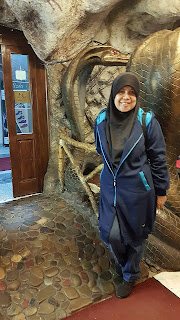
(A large serpent at the restaurant entrance)
(A large serpent at the entrance)

Tonight, feeling overly exhausted and sleepy, we slept early and rested our tired body well.