About Me

Kuala Lumpur, Malaysia
I am married to my loving husband for more than 45 years now. I am a mother to 3 beautiful children, until years ago when I lost my youngest son. Since then my life is forever altered but yet unbroken....
Showing posts with label Tunisia. Show all posts

Thursday, 13 March 2008

Tunisia: Tracing the Berber Trail...

 "A long lasting relationship comes with a lot of forgiveness and understanding..."

(Tunisian puppets with traditional costumes)

The Republic of Tunisia lies in the western region of North Africa. Its northernmost point, Cape Angela, also marks the northern tip of the entire African continent. Tunisia shares borders with Algeria to the west and southwest, and Libya to the southeast - both nations facing ongoing internal conflicts - while the Mediterranean Sea stretches along its northern and eastern coasts.

The majority of Tunisians are of Berber descent. Arabic is the official language, while French is widely spoken and serves as the second language. It is common to see shop signs, menus, and road signs written in both Arabic and French, reflecting the country’s colonial past and multicultural character.

When we decided to venture into Tunisia, I must admit I was a little apprehensive. To prepare ourselves mentally and logistically, we began researching this North African nation - learning about its safety, people and culture, language, currency, navigation, and key attractions. Our plan was to visit most of the major towns across Tunisia, tracing the Berber heritage that threads through its landscapes and history.

Truthfully, Tunisia had never been on my travel wish list - but sometimes the most unexpected journeys become the most memorable.

Tunisia Trip Itinerary:


Tunisia 2008 - 01 Tunisian Revolution and Arab Spring...

 "If you set your goals ridiculously high and it's a failure, you will fail above everyone else's success..." - James Cameron


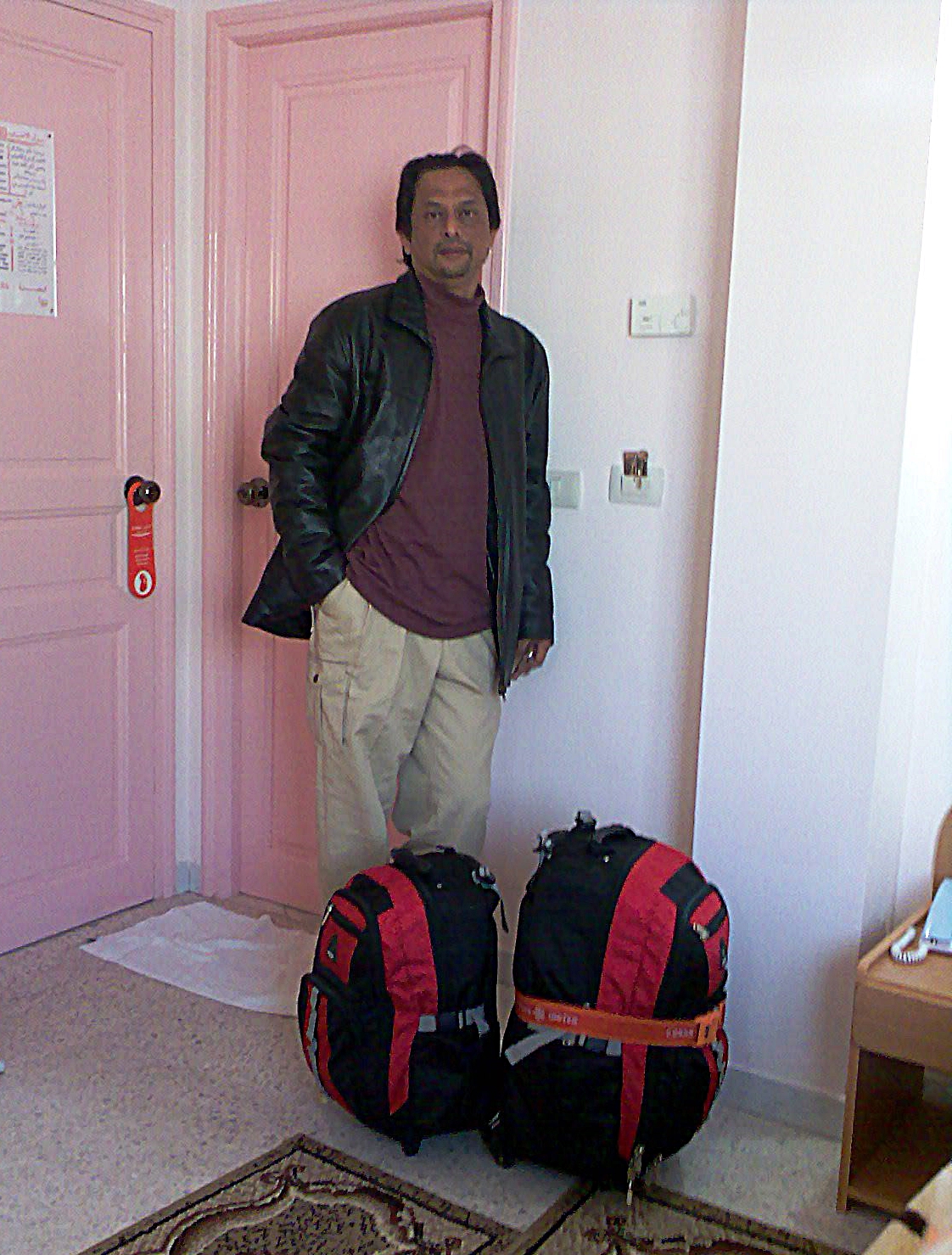
(Checking out of Palermo Hotel, travelling light)

Day 01: 9 March 2008 
(Palermo, Italy – Tunis, Tunisia)

(The Eurostar Salerno Ferry)
(The Grimaldi Ferry)

Our original plan was to spend one week travelling by train from Genoa, a port city in northwest Italy to south of Italy ending our holiday in Palermo then we’ll fly to Athens, Greece. But as Palermo is located nearer to Tunis and there is a ferry route which connects Sicily to Tunisia, we revised our holiday plan and included Tunisia in the itinerary. We pre-booked tickets for The Eurostar Salerno Lines which service runs twice a week with a sailing duration of around 11 hours. Tunisia is a country small enough for us to cover within a week.

(Embarking at the Palermo Port)
(On board an hour before departure)
(Cool ocean wind on the upper deck)
(Crossing the Mediterranean Sea)

At Palermo Port we boarded the Eurostar Salerno ferry around 7.30 p.m. It was nearly 11-hour journey across the ocean from Palermo to Tunis. We slept on the reclining seats in a room filled with Tunisians and tourists amidst the blaring sound from the movie playing on the big screen. Dinner and breakfast were served at the dining hall on the lower deck.

(A light snacks after boarding)
(A mixture of locals and foreign tourists)
(The dining hall on the lower deck)
(Many resting place on board)

We disembarked at La Goulette Cruise Port in Tunis very early in the morning. We met with two young Asian tourists, a Japanese girl and a Chinese boy, both visiting Tunisia for the first time. At the Custom Counter, my back-pack was checked a few times because the x-ray image showed a sharp object. After a thorough check, it was found that the suspicious object was actually the tripod for my camera. After having our luggage successfully scanned and our passports stamped, together with the other tourists we walked quite a distance to the TGM Train Station. Local currency will be required for the train or metro so we changed some Tunisian Dinars at the Money Changer in the port. The train ride to the Tunis City Centre was only one stop away. 

(La Goulette Cruise Harbour)
(Arriving in the city of Tunis)
(Checking in at the Carlton Hotel)

We checked-in Carlton Hotel, an elegant Art Nouveau building in Tunis downtown, 10-minute walk from Tunis Railway Station. It is a short walking distance to the National Library of Tunisia, the Bardo National Museum and the Medina. A breakfast buffet was served in a minimalist dining room with modern furnishings.

(The bistro along the avenue)
(The view of the main avenue)
(The small balcony of the hotel front facade)

As it was still early and the weather was cool, we went for a leisure afternoon walk along the Avenue Habib Bourguiba, where one could find historic architectural buildings and landmarks. Among others are the Cathedral St. Vincent de Paul, the Clocktower, Equestrian Statue of Bourghiba as well as many quaint bistros and cafes. This beautifully tree lined avenue leads to the Medina at one end and the Place Du 7 November Clock Tower with a nice fountain, at the other end.

(The entrance to the old Medina)
(All shops were already closed!)
(One of the government buildings)
(The Cathedral of St. Vincent de Paul)
(The tram criss-crossing the city)
(Many modern buildings too)
(Place Du 7 November Clock Tower)

We had dinner of Tuna Sandwich in the hotel room. After dinner dear hubby went to a nearby coffee shop to buy a cup of hot coffee and had a bad experience with a drunk who tried to extort some money. Luckily the shop Manager came to the rescue. At the hotel we were cautioned not to wonder at night and to beware of pickpockets. In Tunisia, the Medina, on public transport and outer suburbs are not particularly safe after dark especially for foreigners.

(A good night rest)


Wednesday, 12 March 2008

Tunisia 2008 - 02 UNESCO World Heritage...

 "Take care of your thoughts when you are alone, and take care of your words when you are with people..."

(Carthage National Museum)


Day 02: 10 March 2008
(Tunis – Carthage – Sousse – El Jem – Sfax) 

We had breakfast in the hotel and arranged for a car rental. Last night we had plotted our routing to various towns in Tunisia and will be coming back to Tunis at the end of the trip. First stop before we left the city of Tunis was Office de Tourisme where we collected maps and as much brochures as we could on Tunisia tourist attractions and places of interest.

(Punic tombs and early Christian chapel)
(A Carthaginian God Eschmoun Temple)

We met the two Asians and together we drove to our first attractions, the ancient ruins of Carthage. The Carthage National Museum is a national museum in Byrsa, about 20 km from City of Tunis. Along with the Bardo National Museum, it is one of the two main local archaeological museums in the region. The edifice sits atop Byrsa Hill, in the heart of the city of Carthage.

(Archaeological site on Byrsa Hill)
(Interesting artifacts in the gardens)
(The remains of ancient Antonine bath)
(Roman funerary statues)
(A bas-relief of a woman)
(A huge Roman bust)
(Mask and Punic stele)
(Urns containing the ashes of children)
(A 3rd-century marble sarcophagus)

The Carthage National Museum is located near the Cathedral of Saint-Louis of Carthage. It allows visitors to appreciate the magnitude of the city during the Punic and Roman eras. Some of the best pieces found in excavations are limestone/marble carvings, depicting animals, plants and even human sculptures. Of special note is a marble sarcophagus of a priest and priestess from the 3rd century BC, discovered in the necropolis of Carthage. The Museum also has a noted collection of masks and jewellery in cast glass, Roman mosaics including the famous ‘Lady of Carthage’, a vast collection of Roman amphoras. It also contains numerous local items from the period of the Byzantine Empire. Also on display are objects of ivory.

(A beautiful sunny day in the garden)
(Carthage Archeological Museum and Sites)

From Carthage we drove about 165km on the Trans-African Highway to the town of Sousse. Sousse is in the central-east of Tunisia, on the Gulf of Hammamet. The town is considered as one of the best examples of seaward-facing fortifications built by the Arabs with narrow twisted streets, a kasbah and medina, its ribat fortress and long wall on the Mediterranean. Surrounding it is a modern city of long, straight roads and more widely spaced buildings.

(Driving along beautiful beaches)
(The Trans-African Highway)

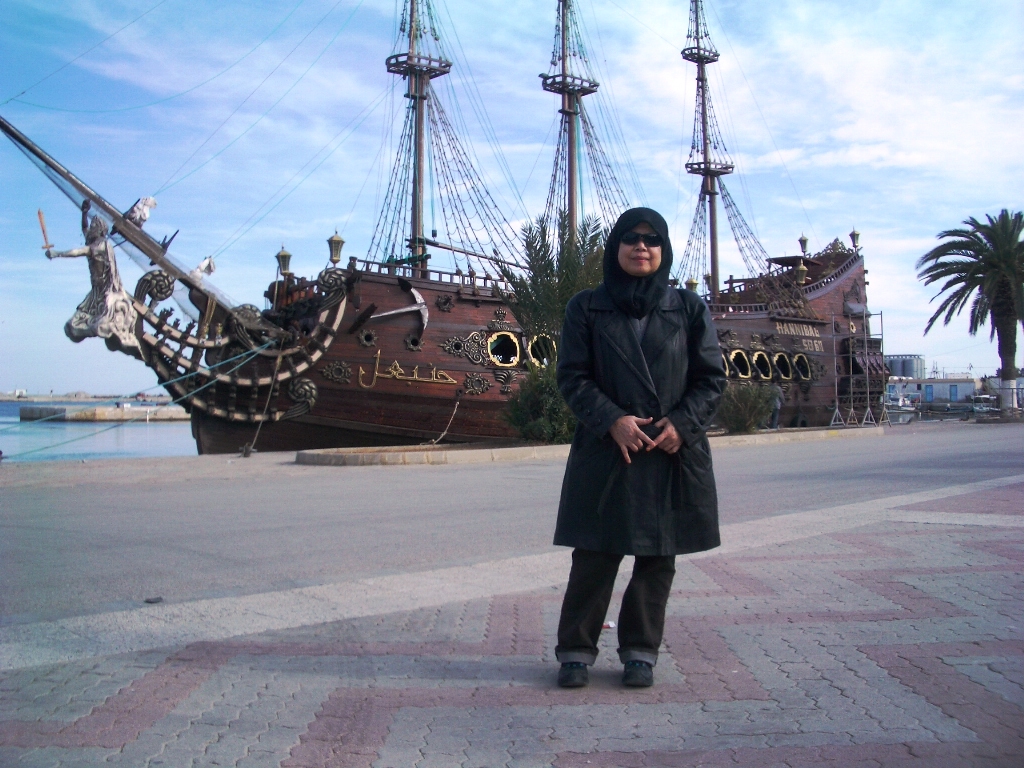
We drove direct to El-Kantaoui Port, a tourist attraction surrounded by lots of shops, bars and restaurants. The Marina is a nice place to go for a stroll. One could take a trip on the pirate ship, go diving or have a trip on a glass bottomed boat. There is access to the beach from the port. 

(A tourist center around a large artificial harbour)
(A tour in the pirate ship at El-Kantoui Port)
(Intricately decorated pirate ship)
(Ribat of Sousse dated back to the Aghlabid era)
(A brief visit to the Medina)
(Pretzels, Tunisian style)

After spending time at El-Kantaoui Port and a brief visit to the Medina we drove on Autoroute A1 towards El-Jem, about 70 km away. The sun was setting fast when we reached The Roman amphitheater. El Jem was formerly the Roman town of Thysdrus, one of the most important towns in North Africa after Carthage. The amphitheater was built around the middle of the third century AD and was thought to house up to 35,000 spectators. This UNESCO World Heritage colosseum was the second-largest in the Roman world after the Colosseum in Rome. El-Jem amphitheater has been used for filming some of the scenes from the films Life of Brian and Gladiator.

(Three levels of arcade stone blocks)
(Most supporting infrastructure has been preserved)

It was already dark and we could not find a hotel to stay around the area. We continued driving towards Sfax, about 70 km away and managed to locate a boutique hotel in the middle of town.

(Checking in late at night)