About Me

Kuala Lumpur, Malaysia
I am married to my loving husband for more than 45 years now. I am a mother to 3 beautiful children, until years ago when I lost my youngest son. Since then my life is forever altered but yet unbroken....
Showing posts with label Azerbaijan. Show all posts

Monday, 30 April 2018

11 Caucasus: Tbilisi, Georgia - Baku, Azerbaijan

"Your mind is a powerful thing. When you fill it with positive thoughts, your life will start to change..."

(Abanotubani Bath House in Old Tbilisi)

Day 11: 25 April 2018 (Wednesday)
Route: Tbilisi City Tour
Hotel: L Plaza Hotel Tbilisi, Georgia 

Today we started our day-tour of Tbilisi a little late.

Tbilisi is protected by Narikala, an ancient fortress overlooking the city and the Kura River. The fortress consists of two walled sections on a steep hill between the sulphur baths and the botanical gardens of Tbilisi.

(Narikala Fortress overlooking the city of Tbilisi)
(Narikala from St Nicholas Church)
(A part of the Fortress wall next to the Cable Car Station)
(Dangerous climb on the ancient wall for a better view of Tbilisi)

The fortress was established in the 4th century as Shuris-tsikhe or Invidious Fort and it was a Persian citadel. It was considerably expanded by the Umayyads in the 7th century and later, by King David the Builder. The Mongols renamed it ‘Narin Qala’ or ‘Little Fortress’.

(St Nicholas Church perched on the rocky hill)
(Another view of the Metekhi church)

On the lower court there is the recently restored St Nicholas church. The new church is of prescribed cross type, having doors on three sides. The internal part of the church is decorated with the frescos showing scenes both from the Bible and history of Georgia.

(The view of Narikala and the city from Metheki Cliff)
(The Monument of King Vakhtang Gorgasali)
(Foreign pilgrims visiting St Nicholas Church)

We visited the Old Tbilisi which is an administrative district in Tbilisi. The term ‘Old Tbilisi" has long been used to denote a historical part of the city. Old Tbilisi is principally centered on what is commonly referred to as the Tbilisi Historic District, which, due to its significant architectural and urban value.

(A visit to the historical Tbilisi)
(The buildings of old Tbilisi)
(Intricate carvings of wooden balconies)
(Wooden houses built on rocky cliff in Old Tbilisi)

The Old Tbilisi district is located on both sides of the Kura River and is dominated by Mount Mtatsminda, Narikala fortress and the Kartlis Deda monument. The district houses churches, museums, sulphur bathhouses, and peculiar wooden houses with open, carved balconies.

(The Fig Gorge with walled embankment)
(Leghvtakhevi or 'fig gorge' is located behind The Sulphur Baths)

The Bath District of the city that holds the sulphuric water is called Abanotubani located underneath Narikala fortress and is quickly identifiable by the the sulphur smell and dome shaped bath houses.

(There are many Bath Houses in Old Tbilisi)
(Old Tbilisi dome-shaped Bath Houses)
(Dome-shaped bathhouse roofs and elaborately tiled entrances)
(Country and Western musicians at the Bath House)

The weather was clear and sunny. It was a nice day for a stroll to Leghvtakhevi Waterfall. The waterfall is surrounded by cliffs situated in the very center of the old city. On the other side of the ridge, in the Botanical Garden.

(A small bridge and a circular staircase at the Fig Gorge)
(A morning stroll along the Fig Gorge)
(A short walk to the waterfalls)

We had to climb the steep narrow streets of Old Tbilisi to visit the Central Mosque, the first Shiite mosque in Tbilisi. It was constructed in the 16th century on the place of the devastated Christian church with the wish of the shah- Suleiman. The eight angled Minaret of the brick mosque draws the attention even from the far distance and is perceived in a different ways from the various sides. The mosque, located at the end of the Botanical garden is the only functioning one at present, and serves the Shiite as well as the Sunnite Muslims.

(The Central Mosque could be access by the circular staircase)
(The eight angled Minaret of the mosque)
(The mosque is made of red bricks)
(The interior of the Shiite Mosque)

After visiting Old Tbilisi we drove pass Freedom Square, named after Ivan Paskevich, the Count of Erivan, a Ukrainian general of the Russian Imperial Army. Under the Soviet Union, the square was renamed, first Beria Square, and then Lenin Square. Freedom Square has been the site of various mass demonstrations including those for Georgia's independence from the Soviet Union. In 2005 Freedom Square was the location where there was an unsuccessful attempt to assassinate U.S. President George W. Bush and Georgian President Mikheil Saakashvili while they were addressing a crowd in celebration of the 60th anniversary marking the end of World War II.

(The Freedom Monument at the centre of the square)

From Freedom Square we drove up the steep road to Kartlis Deda or Mother of a Georgian, a statue erected on the top of Sololaki hill in 1958, the year Tbilisi celebrated its 1500th anniversary. Prominent Georgian sculptor Elguja Amashukeli designed the twenty-metre aluminium figure of a woman in Georgian national dress. She symbolizes the Georgian national character: in her left hand she holds a bowl of wine to greet those who come as friends, and in her right hand is a sword for those who come as enemies. We took a scenic walk along the Sololaki ridge for a panoramic view of Tbilisi.

(Signage to the many attractions)
(The Mother of Georgia Statue)
(The statue on top of Sololaki Hill)
(The statue from below)
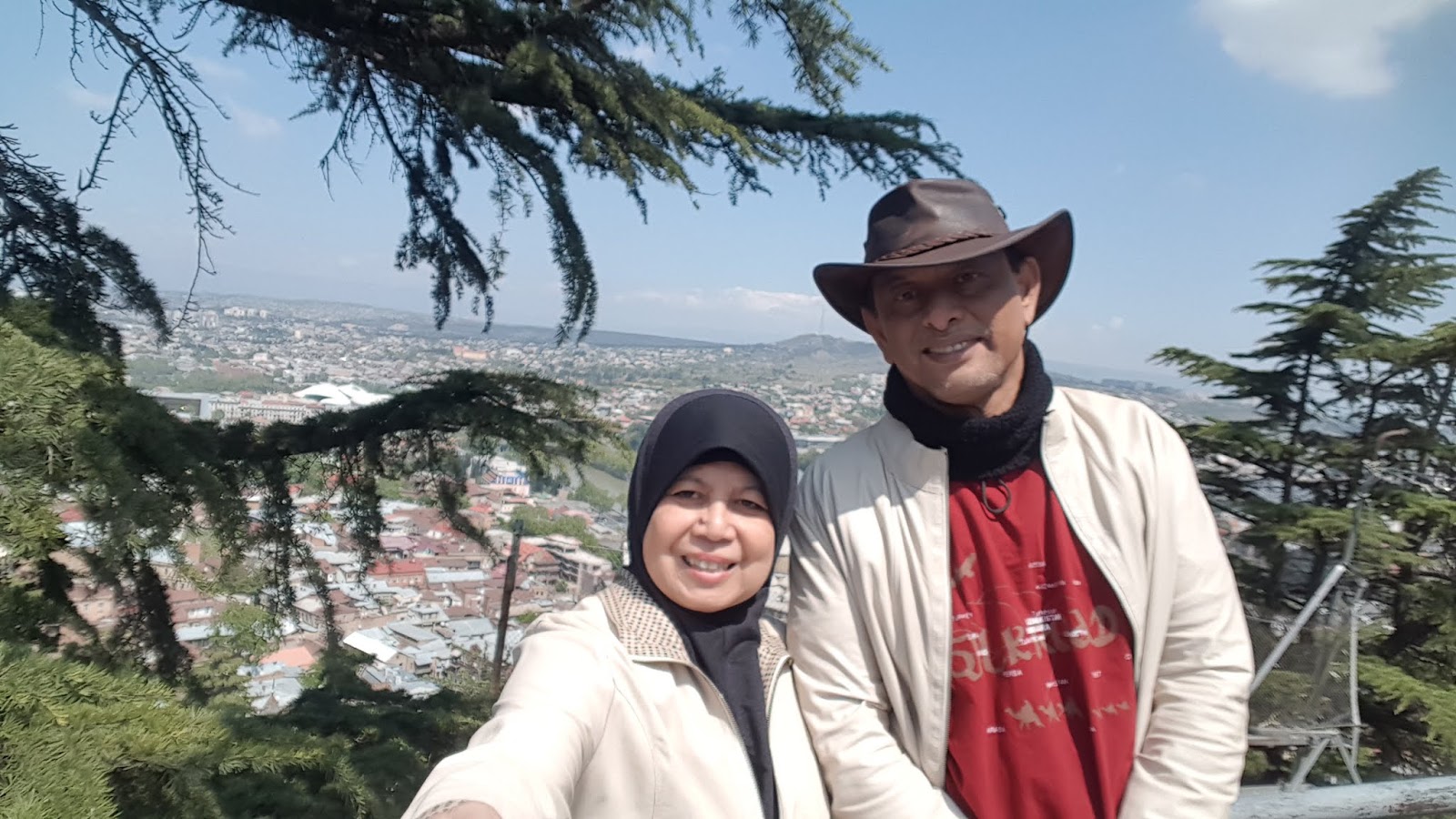
(Tbilisi city from the top of of Sololaki Hill)
(Cable cars operating from the hilltop)

Rustaveli Avenue, formerly known as Golovin Street, is the central avenue in Tbilisi named after the medieval Georgian poet, Shota Rustaveli. The avenue starts at Freedom Square and extends for about 1.5 km in length, before it turns into an extension of Kostava Street. Rustaveli is often considered the main thoroughfare of Tbilisi due to a large number of governmental, public, cultural, and business buildings that are located along or near the avenue. We drove around town and captured the many sights, buildings and modern structures around Tbilisi.

(Holy Trinity Cathedral)
(The Presidential Palace)
(The Philharmonic Building)
(Central Bank of Georgia)
(Public Service Hall building)
(Vultmore Hotel Tbilisi)
(The Pedestrian Bridge of Peace)
(Heroes Memorial in Heroes Square)
(The nine-figure Statue of Clocks)

Lunch was at a Halal New York Burger, a franchise of Mohamad Ali the boxer. We skipped going to Simon Janashia Museum of Georgia, one of the main history museums in Tbilisi as most in the group wanted to go for last minute shopping at The East Point Shopping Mall, a new modern open-concept shopping centre.

(A huge delicious mushroom NY Burger)
(Last minute shopping at East Point Mall)

By 9:30 pm, we packed our bags and checked out. The van transferred us to the airport for our J29226 0120/0230 Buta Airlines flight to Baku, Azerbaijan. When we arrived in Baku Heydar Aliyev International Airport we were transferred by van to Hotel Atlas in Baku.

(Our visa and boarding pass to Azerbaijan)


12 Caucasus: Baku Tour, Azerbaijan

"Great things are always criticized because they have the power to alter the perception of the world..."

(Ancient Caravanserai in Baku Old City)

Day 12: 26 April 2018 (Thursday)
Route: Baku City Tour
Hotel: Atlas Hotel Baku, Azerbaijan 

Republic of Azerbaijan is a country in the South Caucasus region of Eurasia at the crossroads of Eastern Europe and Western Asia. It is bound by the Caspian Sea to the east, Russia to the north, Georgia to the northwest, Armenia to the west and Iran to the south.

(Preparation for the Azerbaijan Grand Prix)
(Military troops for crowd control)

This morning first visit was to Baku Old City. The city centre was crowded with locals and tourist as Baku was hosting the Formula 1 2018 Azerbaijan Grand Prix held between 27 and 29 April 2018 at the Baku City Circuit.

(The main entrance to the old city)
(The medieval wall surrounding the old city)
(A population of about 3000 people)
(Households and shops lining the narrow streets)
(The old city is divided into different quarters)
(A photo opportunity with a local old man)
(An old lady at the souvenir shop)

The Old City is the most ancient part of Baku, which is surrounded by well protected walls. Baku Fortress is the largest of Absheron fortresses. The fortress consists of the Icheri Sheher and the walls and towers surrounding it, and was included by UNESCO into the World Cultural Heritage List. It was built in about 1139 on the order of the Shirvanshah Manuchohr III. The fortress consisted of a double wall. The first wall was built by the Shirvanshah III Manuchohr, and the second wall was built during the time of Shirvanshah Akhsitan I. However, the second fortress walls were destroyed during the reign of Russia in Azerbaijan. Baku Fortress has two gates. One of them opens to the Caspian Sea and the other inland.

(The fortress is reconstructed and restored)
(The wall is protected with canons)
(A monument of Mirza Alakbar Sabir, a poet)

The City Walls provided for Baku's security. In the Middle Ages, the fortress walls were 1500 meters long and now the walls are 500 meters long. In the northern part of the fortress there is a main tower - quadrangular castle. This fortress is called ‘armory’ in the nation's etiology.

(An old caravanserai, an open museum)
(Ancient archaeological artifacts on display)
(The Maiden Tower - temple, observatory or watch tower?)

Muhammad Mosque is the mosque built in the 11th century in Baku Old City. The mosque is also known as Siniggala, for the name of its minaret – ‘damaged tower’. It remained a symbol of the persistence and courage of the defendants of the tower. It is the first building in Azerbaijan, which is related to Islam and dated for its architectural ligature.

(The entrance to Juma Mosque)
(A Pagan Temple converted into a mosque)

Juma mosque has been functioning since the 12th century. This mosque was built in 1899 at the funds of Baku philanthropist Khadja Shikhali Dadashev. The mosque was built on the site of the temple of fire worshipers. Only four uncoated arches remained from the old building, they allegedly belonged to the temple. According to many modern archaeologists, there was a pagan sacred center on the site of Juma Mosque, where the fire worshipers gathered.

(Signage at Juma Mosque)
(The Palace of Shirvanshahs)
The Maiden Tower is a 12th-century monument in the Baku Old City. Along with the Shirvanshahs' Palace, dated to the 15th century. The Palace of the Shirvanshahs together with the Maiden Tower, forms an ensemble of historic monuments inscribed under the UNESCO World Heritage. The complex contains the main building of the palace, Divanhane, the burial-vaults, the shah's mosque with a minaret, Seyid Yahya Bakuvi's mausoleum, a portal in the east, Murad's gate, a reservoir and the remnants of a bath house. The palace is depicted on the obverse of the Azerbaijani 10,000 Manat banknote of 1994-2006 and of the 10 new Manat banknote issued since 2006.

(Flame Tower and Radio/TV Tower in the background)
(The garden at Shirvanshahs' Palace)
(Aliaga Vahid statue, a styrical poet)

In the old city we had the opportunity to visit a remodelled 17th Century Tbilisi Caravanserai from the old Greater Silk Road. Today it is called the Tbilisi Historical Museum housing many art galleries and gift shops on the ground; first and second floors along with a great Wine Bar and Restaurant on the lower floor.

(Ancient Caravanserai converted into a restaurant)
(A well restored caravanserai quarters)
(Fine dining in the Caravanserai Restaurant)

After our lunch at Art Restaurant we visited the corniche by the Caspian Sea where we could view the skyline of Baku from there.

(Lunch at Art Restaurant)
(The corniche by the Caspian Sea)

Next visit was to the historical Bibi-Heybat Mosque outside town. The Bibi-Heybat Mosque includes the tomb of Ukeyma Khanum, a descendant of Prophet Muhammad, and today is the spiritual center for the Muslims of the region and one of the major monuments of Islamic architecture in Azerbaijan. It is locally known as ‘the mosque of Fatima’.

(Bibi-Heybat Mosque)
(The view of the mosque from the main street)
(The mosque is overlooking the Caspian Sea)
(A mausoleum in the mosque)
(Also known as the Mosque of Fatima)

On the way back to town, we stopped at a beach resort by the Caspian Sea for photo shots. We could see the Flame Towers, a trio of skyscrapers in Baku, the tallest in the country, with a height of 182 m. The buildings consist of apartments, a hotel and office blocks.

(The beach by the Caspian Sea)
(The beach at a beach resort)
(The Flame Towers viewed from the beach)

Tonight’s dinner was at Royal Hotel restaurant near Atlas Hotel.