About Me

Kuala Lumpur, Malaysia
I am married to my loving husband for more than 45 years now. I am a mother to 3 beautiful children, until years ago when I lost my youngest son. Since then my life is forever altered but yet unbroken....

Monday, 30 October 2017

South America 2017: 06 Peru - Indigenous Quechua in a laid-back colonial town of Pisac

“He who asks is a fool for five minutes, but he who does not ask remains a fool forever…” - Chinese Proverb

(Pisac Market selling local handicrafts and souvenirs)

Day 06: Saturday, 21 Oct 2017
Route: Lima – Cuzco – Pisac - Sacred Valley

Hotel: Sacred Valley Sonesta Posadas Del Inca Yucay, Peru

(Alejandro Velasco Astete International Airport)
(The shops at the Departure Hall)
(Acclimatization needed for the high attitude)

We checked out of the hotel and were transferred to the airport to board our 07:37 domestic flight to Cuzco. Unfortunately the 07:37 flight was cancelled and replaced with the 9.00 am flight instead. The group was split into two groups flying half an hour apart. Arrived in Cuzco at 10:00 and were met by our guide Mr. Willington and the driver. Both are Quechua originated among the indigenous peoples of South America.

(High altitude hamlets and ruins)
(Andean countryside dotted with villages)
(Beyond lies the Sacred Valley)
(Panoramic view of the Sacred Valley)
(A stunning landscape from the Condor Viewpoint)
(A restaurant and rest area)
(The mountainous narrow road from Cuzco to Sacred Valley)

From the airport we travelled to Pisac enroute to Sacred Valley on Peru Andean Range with an altitude of 3,399 meter. Acclimatization is needed as the air is thin and cold. The Sacred Valley is a region in Peru, along with the nearby town of Cuzco and the ancient city of Machu Picchu, it formed the heart of the Inca Empire. Stretching roughly 60 km, it is an area of fertile farmland and Spanish colonial villages like Pisac and Ollantaytambo. Pisac is known for its Sunday handicraft market and hilltop Incan citadel. On the way to Pisac, we stopped at a viewpoint to have a panoramic view of the Sacred Valley.

Along the way, we noticed that most houses have a pair of miniature ceramic bulls on the middle of their rooftops. This acts as good fortune and protection for the house and the families that inhabit it. This tradition comes from the time of the Incas.

(Talisman, an ancient believe in modern time)
(Entering Pisac region)
(A laid-back colonial town)
(Indigenous Quechua communities from the highland) 
(Lunch in a local restaurant)
(A delicious fish and spinach dishes)

We had lunch at Ulrike’s Cafe, a restaurant at the centre of Pisac Market. Lunch was grilled pink trout and pumpkin soup, very tasty and delicious.

(Handicrafts and souvenirs)
(Local crafts and farmers market)
(Paintings by local artists)
(Cafes and restaurants)

Visited Pisac Market, one of the most famous markets in the Cuzco region. The market draws many visitors to its famous Sunday market when indigenous Quechua communities from the surrounding highlands come to Pisac to sell their produce and stock up on supplies for the week. A large section of the market is dedicated to tourist-oriented souvenir stalls where you can find weavings, jewellery, ponchos, hats, Andean instruments, ceramics, alpaca products and a whole range of other gifts and souvenirs. The handcraft market is open every day from 09:00 to 16.30 and is a good place to pick up some gifts all in the one place.

(Pisac Inca Ruins)
(A doorway marking the Entrance)
(A flute player at the Pisac Ruins)
(The highest point of the Pisac Ruins)
(Thin and dry air on the mountain top)
(Inca villages and ruins)
(The village with the plunging gorge on either side)
(Vast sweeping agricultural terraces)
(The citadel across the hill terrace)
(The hilltop Inca citadel)
(A street vendor)

After spending a few hours in the Pisac Market, we travelled up the mountains to visit Pisac Ruins known as Inca Písac which lie atop a hill at the entrance to the valley. They are separated into four areas stretching along the picturesque ridge- Pisaqa, Intihuatana, Q’allaqasa, and Kinchiracay. The settlement is built on row upon row of fine stone terraces, laid out on a natural balcony. The layout is thought to represent a partridge’s wing. Visitors to the upper sector are rewarded with spectacular panoramic views of the Andes Mountains. The main Temple of the Sun is built on a huge protruding spur of volcanic rock. There are also baths, altars, water fountains and a ceremonial platform whilst above these ruins lie several ancient burial sites, many still unexcavated.

(Drinking glasses of coca tea to fight altitude sickness)

We overnight in Sacred Valley Sonesta Posadas Del Inca Yucay. Tonight, some in our group started to experience Acute Mountain Sickness and were having severe headaches and nauseating.


South America 2017: 07 Peru - Wondering in the Ancient City of Machu Pichu...

“The broad-minded see the truth in different religions, the narrow-minded see only the differences…” – Chinese Proverb

(The Ancient City of Machu Pichu)

Day 07: Sunday, 22 Oct 2017
Route: Sacred Valley - Machu Picchu - Sacred Valley
Hotel: Sacred Valley Sonesta Posadas Del Inca Yucay Hotel, Peru


(A former colonial-style monastery)
(Our room on the ground floor)
(A hearty buffet breakfast)
(A contemporary accommodation with rustic decorative features)
(Our lodging for two nights)

Early in the morning we travelled by bus to Ollanta Train Station at an altitude of 2,790 meter. Boarded the 09:30 Peru Train to Aguas Calientes. The train is modern and the carriages have large panoramic windows for passengers to appreciate the scenery of the countryside. In the train we were served with light meals of sandwiches and drinks. The train journey took around 2 hours. At Aquas Clientes Train Station we performed our prayers at one of the restaurant.

(The train tickets to Machu Pichu)
(A sunny morning for the trip)
(The Ollantay Tambo Train Station)
(Waiting for the train to Aguas Calientes)
(Boarding the Peru Rail)
(Comfortable train ride with light snacks)

Later, from Aquas Clientes we boarded a shuttle eco-bus to Machu Picchu peak. We had our packed lunch while the guide bought tickets to enter the ancient city. We had to show our passports and tickets at the entrance.

(Arriving at Aguas Clientes Train Station)
(Roaming around town)
(The Machu Pichu signage)
(The Inca Warrior and his Condor)
(Taking the green Eco-bus to the peak)

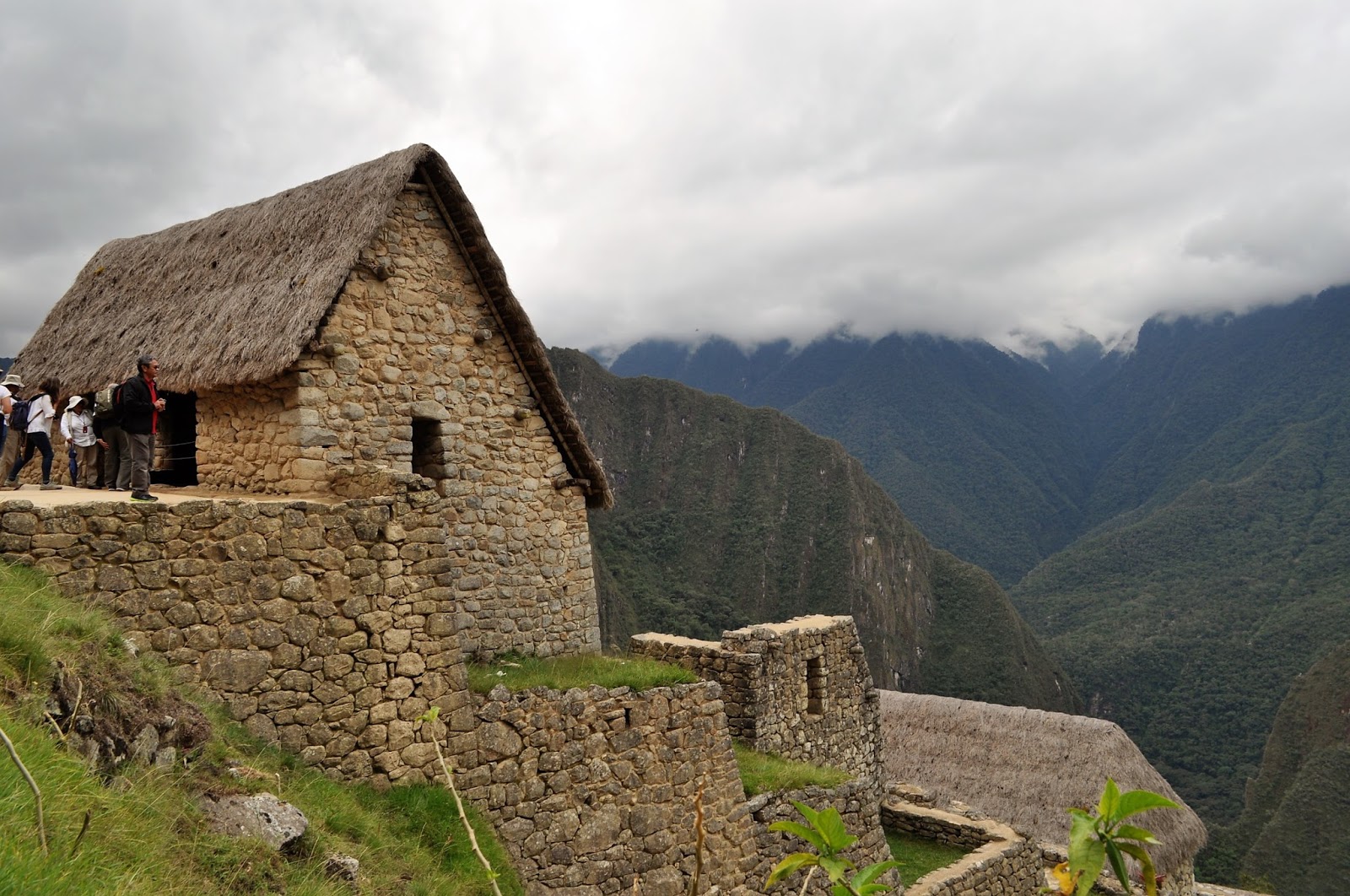
Machu Picchu is at an altitude of 2,450 meter. It is a 15th Century Incan Citadel set high in the Andes Mountains in Peru, above the Urubamba River valley. A UNESCO site, Machu Picchu is an Incan citadel set high in the Andes Mountains in Peru, above the Urubamba River valley. Built in the 15th century and later abandoned, it is renowned for its sophisticated dry-stone walls that fuse huge blocks without the use of mortar, intriguing buildings that play on astronomical alignments and panoramic views. Its exact former use remains a mystery. We had a guided tour of the ancient city at our own leisure time. The weather was cool and bright. We were lucky that Machu Pichu was not so crowded during this time of the year and we have the whole place to ourselves to explore. 

(Passport and ticket to enter Machu Pichu UNESCO site)
(A first glimpse of the Incan Citadel)
(A citadel high in the Andes Mountain)
(Dry stone walls and huge blocks buildings)
(One of the Seven Wonders of the World)
(High above the Urubamba River Valley)
(The resident Llama in the ruins)
(The long and winding road from above)

We stamped our passports after we completed the Machu Pichu tour and boarded the bus back to Aquas Clientes. We returned by train to Ollanta and had light meals, accompanied by a fashion show on the train. From the Ollanta Train Station we boarded the bus back to the hotel.

(The Urubamba river running across town)
(A popular hotel for tourists)
(A fashion and cultural show on the train)

Tonight we skipped dinner and went to bed early. We overnight again in Sacred Valley Sonesta Posadas Del Inca Yucay Hotel.