About Me

Kuala Lumpur, Malaysia
I am married to my loving husband for more than 45 years now. I am a mother to 3 beautiful children, until years ago when I lost my youngest son. Since then my life is forever altered but yet unbroken....

Monday, 21 March 2016

2016 Iran Day 14: Tehran - KL

"We  are not perfect, we are learning. That's the beauty in our specific learning..."

(Please leave your shoes outside)

Day 14: Monday, 20 Mar 2016
Route: Tehran - KL
Flight W5 083 IKA/KUL


This morning we celebrated the Nowruz together with the hotel guests and staff.

Nowruz is the name of the Iranian New Year, also known as the Persian New Year, which is celebrated worldwide by Iranian peoples, along with some other ethno-linguistic groups, as the beginning of the New Year.

(A rose for the hotel guests)
(Listening to Khameini New Year greetings on TV)

Nowruz is the day of the vernal equinox, and marks the beginning of spring in the Northern Hemisphere. It usually occurs on March 21 or the previous/following day, depending on where it is observed. Although having Iranian and religious Zoroastrian origins, Nowruz has been celebrated by people from diverse ethno-linguistic communities for thousands of years. It is a secular holiday for most celebrants that is enjoyed by people of several different faiths, but remains a holy day for Zoroastrians.

(A large poster of happy faces of Iranians)

Carpet Museum, Tehran

This morning we visited the Carpet Museum located in Tehran, beside Laleh Park. The Carpet Museum exhibits a variety of Persian carpets from all over Iran, dating from the 18th century to the present. The museum's exhibition hall occupies 3,400 square meters and its library contains 7,000 books.

(The Carpet Museum is opened on public holiday)
(Beautiful yellow flowers outside the Museum)

(Shoes cover to protect the carpets from dirt and dust)

The museum was designed by the last Queen of Iran, Farah Diba Pahlavi. The perforated structure around the museum's exterior is designed both to resemble a carpet loom, and to cast shade on the exterior walls, reducing the impact of the hot summer sun on the interior temperature.

(Carpet display in the museum)
(Waiting for our bus outside the museum)
(Artistic decorative staircase)
(Another decorated staircase)
(Easter eggs in the park)
(Lamb kebab and fries)
(Beautifully colored flowers)

Niavaran Cultural/Historic Complex

The Niavaran Complex‎ is a historical complex situated in Shemiran, Tehran. It consists of several buildings and monuments built in the Qajar and Pahlavi eras. Its formation dates back to the Qajar Dynasty. This Complex which has been changed to a museum after the Islamic Revolution was administered jointly with Sa’adabad Complex. Presently, it is comprised of five museums Niavaran Palace Museum, Ahmad Shahi Pavilion, Sahebqaranieh Palace, Jahan Nama museum and the private library, and other cultural, historical and natural attractions including the Blue Hall, Private Cinema, Jahan Nama Gallery, and Niavaran Garden.

(Buildings and monuments built in the Qajar and Pahlavi eras)
(Saheb Qaranie House)
(A clear blue sky)
(The Kushak of Ahmad Shah)
(The Niavaran House)
(Walking in the woods of Niavaran Complex)
(Mosaic tiles decorating the wall)

We had lunch at a local restaurant in town then went back to the hotel to pick up our luggage. On the way to the hotel we passed the Tabiat Bridge, which is the largest pedestrian overpass built in Tehran. The 270 metre bridge connects two public parks, Teleghani Park and Abo-Atash Park by spanning the Shahid Modarres, one of the main highways in northern Tehran.

We performed our prayers in the hotel before we boarded the bus to the airport. Our Mahan Air flight W5 083 IKA/KUL arrived in KLIA safely on time.

(Tabiat Bridge, the longest pedestrian bridge)
(Arriving at the airport just in time to check-in)
(In KLIA, Iwan just arrived from LA the same time too)

Alhamdulillah…..


Monday, 22 February 2016

Thailand 2016: Dams and Lakes Ride - Pristine waters of Ratchabrabha Dam...

"Over every mountain there is a path, although it may not be seen from the valley..." - Theodore Roethke

(The lake, the dam and me)

Date: 18 – 22 February 2016
Route: KL – Changlun – Ratchaprabha Dam – Thale Noi – Hatyai – KL
Total Distance: 1,850 km

Day 01: 18 February 2016 (Thursday)
Route: KL – Changlun
Distance: 467 km

Hotel: Changlun T-Hotel

After my nurse duty in Melaka, we drove back to our Bidara House to pack and started riding towards north. Night-riding is strangely peaceful. Although there was less traffic, we rode with extra care and reached Changlun before midnight.

We decided to stay a night at T-Hotel for RM90/night inclusive of breakfast.

Day 02: 19 February (Friday)
Route: Changlun – Ratchaprabha Dam
Distance: 421 km

Hotel: Beautiful Muslim Resort

It was raining cats and dogs early in the morning. After breakfast we went to the coffee shop under the tree to get our documentations done and changed some bahts. By 10.00 am we were ready to cross the border into Thailand. Border crossing at Bukit Kayu Hitam was smooth. We rode towards Surat Thani and made a few pit stops for refueling and short rests.

(Caught in the early morning showers)
(The junction to Khao Sok National Park)
(A welcoming signage to Ratchaprabha Dam)

Around 3.30 pm we reached the junction to Khao Sok National Park. Cheow Lan Lake or Ratchaprapha Dam Reservoir is in the National Park, located 70 km west from Surat Thani on Highway 401. The Cheow Lan Lake is really worth visiting for its spectacular vistas of the natural beauty and pristine waters. The last time we were here was in March 2014 with five other bikers but we didn’t have time to explore the Cheow Lan Lake.

(The road leading to the pier)
(A glimpse of the Cheow Lan Lake)

The Ratchaprabha Dam was completed in 1987, serves as the hydroelectric power generator. As a result, it also creates a beautiful gigantic reservoir with a large number of towering limestone mountains and small and large islands which once were limestone peaks. Moss underneath the deep water enhances the emerald green colour of water in the lake making it looks more like sea water.

(The viewpoint and rest area)
(The statue of a scholar at the viewpoint)
(Clean rest area, ideal for a picnic)
(A nice view of the dam up ahead)
(The two of us, the dam in the background)
(The Ratchaprabha Dam on a man-made lake)

As it was already late afternoon, at the Tourist Information Centre, we enquired on accommodation on the raft houses on the lake but to our disappointment all chalets were fully booked. We then decided to look for alternative lodging and planned for a lake tour early tomorrow morning.

We spent the night in a chalet, a few minutes ride from the dam. The chalets are owned by a muslim couple and there is a halal restaurant nearby.

(Riding out from the pier)
(A lodging very near to the lake)
(A cluster of boutique chalets)
(Our lodging for the night)

Day 03: 20 February 2016 (Saturday)
Route: Tour of the Ratchaprabha Dam

We had a heavy breakfast at the restaurant by the jetty.

Later we rented a long-tail boat for a 2-hour tour of the lake just for the two of us. We paid B1,500 for the boat and the tour guide. We also had to pay entrance fee of B300 per person to enter the Khao Sok National Park.

(Heart-shaped pancakes and honey for breakfast)
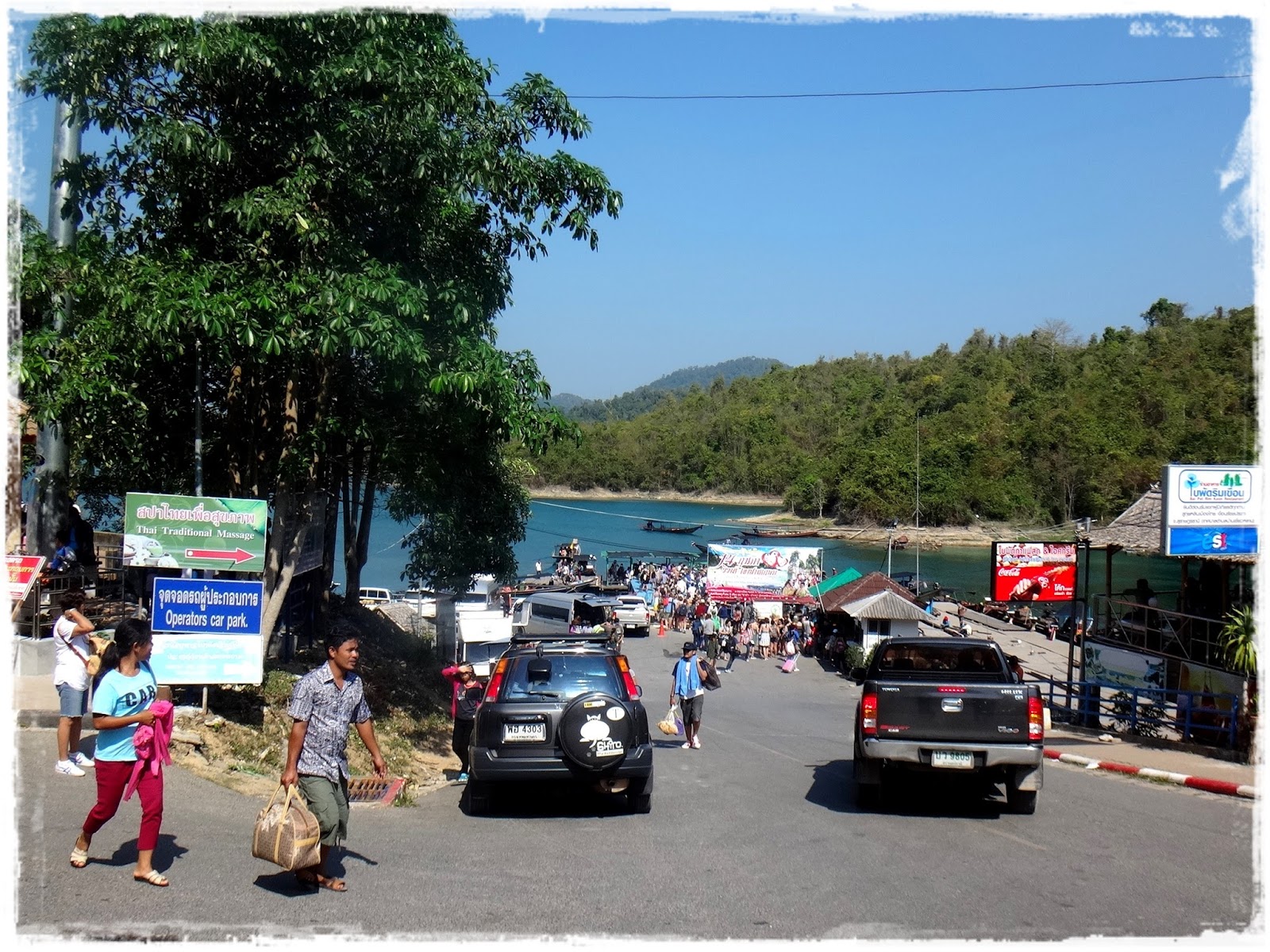
(The pier was busy with tourists)
(Buying tickets to enter the National Park)
(Busy long-tail boats ferrying tourists)

The long-tail boat trip took us to watch the picturesque scenery of the lake. Surrounded by peaceful nature will give you an unforgettable experience and a good photo opportunity of the landscape and the beautiful sight of ‘the Guilin of Thailand’. From there the boat ride continued further to the the floating bamboo chalets where one can have a light refreshment or lunch there. 

If you are staying of the floating chalets, the boat will take you slightly further for jungle trekking or observe wild animals at night. Swimming and canoeing are equally interesting activities to do. For adventure lovers, you can join a cave expedition. In the nearby area there are a few caves to explore. One is Nam Tha Lu Cave and the other is Pakarang Cave.

(Feeling all excited to explore the lake)
(Life jacket is a must on the boat ride)
(Limestone structures jutting out of the water)
(A clear weather with blue sky and emerald green water)
(Venturing in between beautiful limestone hills)
(Nick-named as 'The Guilin of Thailand')
(A couple shot by the guide)
(Lodging on the bamboo rafts)
(Varieties of chalets to choose from)
(A simple raft house with basic amenities)
(Swimming and kayaking by the chalets)
(A simple lodging on water)
(The lobby and a floating restaurant)
(Tranquil and serene surroundings)
(A must stay, next time)
(We are happy to be here, at last...)
(Abundance of fish, but no fishing please...)
(Capturing the scenery on the way back to the jetty)
(A long-tail boat waiting for customers)

After the 2-hour boat ride we rode back to have lunch at the Muslim restaurant and checked out. This afternoon we rode towards Phatthalung and would be exploring Lake Thale Noi next.

(A busy pier at the dam)
(Tourists coming back from the lake tour)
(A sumptuous seafood lunch at a Muslim restaurant)