About Me

Kuala Lumpur, Malaysia
I am married to my loving husband for more than 45 years now. I am a mother to 3 beautiful children, until years ago when I lost my youngest son. Since then my life is forever altered but yet unbroken....

Friday, 29 January 2010

Taiwan 2010 - Fun on an Island Nation...

"Whatever you want to do, do it now. There are only so many tomorrows..."

After an hour stopover in Kota Kinabalu, we arrived in Taiwan Taoyuan International Airport late Friday night.

The airport commenced operations in 1979 as Chiang Kai-shek International Airport in memory of former President of the Republic of China, Chiang Kai-shek. In 2006, the name was changed to Taoyuan International Airport. The overall layout is simple and traveler friendly.

John Duang, our local host was waiting for us at the arrival gates and we were whisked off to the Cosmos Hotel Taipei, located at the heart of the city's most prosperous financial district. It is adjacent to the Taipei Train Station and the bus main station. After a brief checking in process, we unpacked and rested for the night.

(Arriving at the hotel)

Pigeon Racing

Early next morning we began our tour. During the drive south to Taichung, John pointed out the numerous red and blue pigeon coops on rooftops. The Japanese introduced pigeon racing to Taiwan early last century. This curious combination of sport, gambling, and animal husbandry was an instant hit. It seized the hearts and minds of the people in Taiwan. The pigeons eat birdseed and grit, but the racing itself is fueled by cash. Money is what makes pigeon racing so popular though gambling is illegal in Taiwan. The lucky owners make a lot of money, the stakes can be very high and could reach almost US$3 million, and any bird that does well in a seven-race season is automatically worth more than US$20,000. These racing pigeons are measured by a simple yardstick, their race results. Thieves throw up nets to snare the little aviators and hold them for ransom.

The Wu Chang Temple

Through multi level mountain highways intersecting each other, approaching Taichung, we had no idea of the horrific damage inflicted by the 7.3 magnitude earthquake that shook the island eleven years ago. To ensure the unimaginable power nature unleashed on Taiwan that day was never totally forgotten, several sites around the island had been left exactly as they were after that terrible night.

When that earthquake hit Taiwan, the Wu Chang Temple collapsed leaving the temple in ruins. This is perhaps the most famous and often visited temple in the town of Jiji in Nantou County, situated close to the quake’s epicentre. The remains of the village’s Wu Chang Temple whose first floor entirely collapsed is a dramatic sight.

(The temple damaged by the earthquake)

The Sun Moon Lake

Driving onwards and upwards, we headed towards the Sun Moon Lake. Surrounded by green mountains, the 8km square Sun Moon Lake is the pearl of Central Taiwan. It is the largest natural lake in Taiwan. It is a beautiful alpine lake, divided by the tiny Lalu Island. The Eastern part of the lake is round like the sun, while the Western part is shaped like a crescent moon - hence the name "Sun Moon Lake".

(The Sun Moon Lake)

Its crystalline, emerald green waters reflect the hills and mountains which rise on all sides. Natural beauty is enhanced by numerous cultural and historical sites. Its beauty is created by the combination of mountain and water scenery, and its 760-meter elevation helps give the impression of a Chinese landscape painting with mist-laden water and clearly defined levels of mountains.

(The hills and mountains surrounding the lake)

Thao Chieftains House

We made a brief stop at a Thao Chieftains house. The Thao represent the smallest of Taiwan's indigenous, non Chinese, population, with just over 500 members. Pictures on the wall showed world dignitaries who has visited the Chieftain in the past. The Thao claim that they produce the world’s best Royal Jelly. Their colourful vests were prominently displayed for sale.

Peacock Garden Park

We followed the winding road bordering the lake to the Peacock Garden Park. It has over 200 peacocks and other rare and valuable birds. Over 100 other species live in this park, including the mountain chicken, the Formosan blue magpie, the long-tailed pheasant, the golden pheasant, the ampherst pheasant, and the black coot. The park seems to be a popular vacation spot for the locals.

(A peacock garden)

The Wenwu Temple

During the Japanese occupation period there were two temples on the banks of the lake: Longfong Temple in Shueishe Village and Yihua Hall in what is now Yitashao. But when the Japanese built their hydroelectric power plants, the water levels rose, and the temples had to be removed. The Japanese electric company paid compensation, and the temple managers decided to combine their resources and build a single new temple at Songboling on the northern shore of the lake. The result was the Wenwu Temple.

This Wenwu temple was built in 1938, combining two temples that had to be relocated when the dam was constructed. It was rebuilt in 1969. This temple of literature and martial arts has a pair of lions in front of the temple, reputed to be the largest in Taiwan.

(The Wenwu Temple)

Chung Tai Chan Monastery

Leaving Taichung, we sped off towards Puli. Located there in Taiwan's Nantou County is the Chung Tai Chan Monastery. Its construction began in 1990 and lasted for a whole decade. The structure was designed by the renowned Taiwanese architect, Li Tsu-Yuan, and combines both Chinese and Western architectural designs.

(The monks cleaning the garden)

The main building of the monastery stretches vertically, in sharp contrast to many traditional Chinese temples which are horizontally extended. The primary building material is stone, which represents the firmness of Buddhist belief. It also depicts longevity.

The monastery pursues the main tenets espoused for mankind:
1. Respect subdues arrogance
2. Kindness dispels anger
3. Harmony overcomes rudeness and violence
4. Truthfulness eradicates deceit

(A statue made of Jade)

The main structure stands upright among other lower buildings and the surrounding hills, resembling a saint sitting in the green woods. This symbolizes a pursuit of eternal peace, which is the Buddhist goal. The monastery can be seen as a symbol of hope for the people in the surrounding villages.

More than one hundred thousand religious followers come to visit Chung Tai Chan Monastery every year. Other local and international visitors come to participate in art and science seminars in the confines of the monastery's architectural beauty.

(Religious sayings at the entrance)

Feng Chia Night Market

John assured us that he was bringing us to a night market that provides the most diverse, delicious, and non-traditional Taiwanese snacks, the Feng Chia Night Market!

(A street performer)

The Feng Chia Night Market situated in the Situn District in Taichung City is full of people. It offers a wider array of Taiwanese snacks, drinks, food shops, and fashion goods at competitive prices. More than 1,000 shops and food stalls line Wenhua Road, Feng Chia Road, Fushing Road, and Hsian Road. As we waded through the crowd, smells of stinking tofu wafted through the market. Of course there were various varieties of Taiwanese dishes on sale. Even Turkish Ice Cream can be found here!

Fun Won Hotel

Our Ful Won hotel is located on a convenient traffic entrance connected to Zhonggang Road and Wensin Road. Surrounding it are many large department stores, the Feng Chia night market, the Jingming commercial zone and the Chung-Shan Institute of Science and Technology. It’s a nice cosy hotel to rest our tired bones.

(A decent hotel room)

Leofoo Village Theme Park

Located in Guansi Township in Hsinchu County, Leofoo Village Theme Park is the largest theme park in Taiwan. Leofoo Village Theme Park comprises a well segmented wildlife zoo and four other theme parks. Enroute to the park, it is like a fairytale castle, it’s most famous feature, rising in the middle of the surrounding forest.

(Visiting a Theme Park)

In Chinese ‘Leo’ means ‘six’ and ‘Foo’ stands for ‘luck’. Thus the park symbolizes six lucks. The Theme Park was established in 1994 and has received overwhelming response from the domestic as well as the foreign tourists. It took only couple of years after its opening for the number of visitors to the Park to touch the figures of 2.3 million. This figure surpassed Taiwan’s tourist record.

Apart from a wild life zoo, Leofoo Village Theme Park has a four other theme parks, the Wild West, the Arabian Palace, the South Pacific and the Safari Park. Newer themes like China Town, the Wildlife and the Fairy Tales are slated to be added to the park soon. The Park is also planning to include a huge garden and an international hotel.

There are also fun rides like the Volcano Adventures, 360 degree Roller Coasters, pendulum themed Pirate Ships and the Jurassic Park. We were treated to an MJ dance routine in the theme streets. Costumed staff depicting cowboys, arabian warriors and south pacific natives mingled freely with the visitors.

Pi Xiu Museum

We stopped at a Pi Xiu museum on the way back to Taipei. In Chinese Feng Shui, a Pi Xiu is a mythical animal which is depicted with the head of a dragon and a dog or lion's body often with hoofs, little wings and a tail.

The Pi Xiu is a loyal guardian that is frequently seen guarding the tombs of emperors or on the roofs of important buildings. It is believed a Pi Xiu absorbs evil and as it has no anus the evil cannot escape and infect the place it protects. It also absorbs wealth from all directions and signifies money coming in without going out which is why they are often depicted with a full belly standing on a bed of Chinese coins. It is said that you do not simple buy a Pi Xiu. The Pi Xiu chooses you!

Ximending

Located in west Taipei, Ximending is one of the most popular tourist spots among locals and visitors from all over the world. Ximending features a wide array of fashion clothing and accessories in various styles including Japanese, Chinese and Western.

(High-rise buildings in town)

Ximending is similar to the fashionable streets of major cities in the world like the Shibuya in Japan, Wang Fu Jing of Beijing, Nanjing Road of Shanghai, Drottninggatan of Stockholm, and Petaling Street of KL to name a few. All are famed for a diversity of entertainment and activities that allure young people and young adults to visit.

(A local scoot)

With packed breakfasts provided by the hotel, we left the hotel before dawn. Arriving still in the dark at the airport, we flew home in the early morning mist...

Thursday, 17 December 2009

Uzbekistan 2009 - The Ancient Silk Road...

“Jobs fill your pocket, but adventures fill your soul.” – Jamie Lyn Beatty

Image result for nasreddin hodja bukhara
(Nasreddin Hodja a.k.a Abu Nawas in Bukhara)

Buxoro, Samarkand and Tashkent, Uzbekistan
(9 - 16 December 2009)

Uzbekistan is within the South-Central Asian Union and has borders with other member states of Afghanistan, Kazakhstan, Kyrgyzstan, Tajikistan and Turkmenistan. It is doubly landlocked, but includes the southern shoreline of the Aral Sea.

Uzbekistan is a former Soviet republic. It's known for its mosques, mausoleums and other sites linked to the Silk Road, the ancient trade route between China and the Mediterranean. For this trip, we joined a few Bank Negara ladies to trace the ancient Silk Route in Uzbekistan and would be visiting the historical cities of Bukhara, Samarkand and Tashkent.

The Tour Leader for this trip is Ustaz Sobri of Poto Travel.


Wednesday, 16 December 2009

The Silk Road Uzbekistan 2009: 01 Buxoro - The City of Caravansary...

"If you want something you've never had then you've got to do something you've never done..."


After a seven hour overnight Uzbek Air flight plus a five hour local departure delay, we landed safely in Bukhara and checked in at the Grand Bukhara Hotel.

(Arriving in Uzbekistan International Airport)

The city is locally known as Buxoro. A caravansary city rich in history and dramatic architecture. The city’s most famous landmark, the Kalyan Minaret is the greatest remnant of truly old Bukhara; Genghis Khan destroyed most of the city, but left the minaret standing, supposedly because he was struck by its beauty. Locals take wedding pictures with this minaret as a symbol of their undying love.

(Mir-i-Arab Madrasah)

Part of the Kalyan Ensemble, the Mir-i Arab Madrasah was built across from the Kalyan Mosque in the 1530's, during the reign of Ubaydallah Khan, of the Shaybanid in Bukhara. It is still an active madrasah. Like the Kalyan Mosque, it exhibits traditional four courtyards. Over one hundred spacious student cells are located behind the double-height courtyard arcade. Each of the courtyard façades contains a central area that functions as a summer classroom. The tomb of the madrasah's founder, Mir-i Arab, occupies the largest classroom, located behind the main façade.

(The Ark, Bukhara Fortress)

Bukhara, with its population of a quarter of a million, is a major attraction for travellers following the old Silk Road. Celebrating its 2,500th anniversary Bukhara’s mud-coloured buildings, the city’s subdued desert hues and centuries old buildings exude their own exotic air of ancient culture.

(An old Bukhara painting on goat skin)

The tenth century Ismail Samani Mausoleum is one of Bukhara's oldest monuments. Built for the founder of the Samanid dynasty, its delicate terracotta brickwork disguises 2metre thick walls that have never needed repair in the 1100 years it has stood here. Ancient technology at its best.

(Visiting famous mausoleums in the snow)

Close by is another mausoleum with a conical cupola. It is said that Nabi Ayub struck the ground with his staff and hit upon a life giving spring of water during a drought when crops, animals and people perished. This mausoleum was erected over that spring.

(Carpet hunting around town)

Ancient souks with shops named “Ali Baba and the Forty Robberies” sells traditional carpets, ceramics and modern wares. Age old hamams (turkish baths) can be found all over the city. In winter, the blowing winds relentlessly reminds visitors of the hardship endured by its inhabitants. Fur hats and warm gear are sold everywhere by street vendors to ward off the cold.

(Head gear protects the brain from freezing)

Twenty minutes from Bukhara lies the Sufi shrine complex of Bahauddin Nakshabandi. It’s a large complex with a main mosque. There is a large petrified tree supposedly blessed. Pilgrims walk around it and under its branches and tie knots onto the tree saying silent prayers. People come here from all over Uzbekistan as it is considered by some as an adequate substitution for the Hajj Pilgrimage to Mecca.

(A pilgrimage site to the locals)

We had typical Uzbek food which consists of bread and a variety of salad, a soup/stew followed by the main meat course. Green or oolong tea flowed copiously during each meal. Our search for the well known Nasi Bokhara led to the discovery that there are more than a dozen varieties of Pilaf Rice throughout Uzbekistan. And Pilaf Rice in Bukhara would be Nasi Bukhara, in Samarkand it would be Nasi Samarkand and Nasi Tashkent in Tashkent. Anyone found Mee Bandung in Bandung? All in all, we enjoyed the food varieties.

(A typical meal for dinner)


Sunday, 13 December 2009

The Silk Road Uzbekistan 2009: 02 Samarkand - City of Legends...

"You can have results or excuses, not both..."

After a five hour drive, during which we saw the snow covered majestic mountain borders of Uzbekistan, we reached Samarkand. This hilly city is the second largest in Uzbekistan and is as old as Rome, Athens and Babylon. Situated on the Silk Road, ancient Arabs called it the “Gem of the East”, Europeans called it the “The Land of Scientists”. Ulugbhek built his observatory here and charted the stars even before astronomy was invented.

(Ulugbhek Observatory)

Samarkand is the city of legends. When Alexander the Great saw Samarkand, he exclaimed “I heard that the city was beautiful but never thought that it could be so beautiful and majestic”. It’s also a city of love akin to Shakespeare’s tragic Romeo and Juliet but with Samar and Qand miraculously brought back to life at the end.

(A love story of Samar and Qand)

One ancient poet wrote:

You can travel through the whole world, have a look at the pyramids and admire the smile of the Sphinx; You can listen to the soft singing of the wind at the Adriatic Sea and kneel down reverently at the ruins of the Acropolis, be dazzled by Rome with its Forum and Coliseum, be charmed by Notre Dame in Paris or by the old domes of Milan; But if you have seen buildings of Samarkanda, you will be enchanted by its magic forever....

(The mausoleum of Nabi Danial)

It is believed that parts of Nabi Danial remains, namely a hand, were conveyed to Samarkand by Timur. A mausoleum was constructed over the burial place of this remains. Quite near to the mausoleum there is a spring with water considered sacred. The locals say that everyone wishing to visit this mausoleum should have a drink of this water and wash the open parts of their body. This is a place of pilgrimage for both local residents and international guests. In 1996, the Patriarch of All Russia Alexey II visited this mausoleum and sanctified it. The locals say, after sanctifying the mausoleum, a pistachio tree in the courtyard thought dead, began to blossom again.

(The Shah-i-Zinda Necropolis)

In this city too, is situated one of the world’s notable architectural ensemble of the Samarkand, the Shah-i-Zinda necropolis. It’s also called the Street Of the Dead. Thirty five steps up leads to the eleven mausoleums. The most ancient is the ensemble of Kusam ibn-Abbas, a cousin of our revered prophet, Nabi Muhammad SAW. This ensemble is a monument of the warriors who charted world history. We ended the day at dusk at this beautiful ensemble to return to our hotel the Regal Palace.

(Memorial Complex of Imam al-Bukhari)

Early next morning, we set off to the most famous attraction in Samarkand is the Imam al-Bukhari Memorial Complex which is located in Kharteng village, 12 kilometers from Samarkand. The complex includes mausoleums, mosques and administrative buildings.

The Imam al-Bukhari mausoleum is located in the center of this complex. This cubical building is crowned with a seventeen-meter dome. The right side door leads downstairs to a do dakhma, a place of worship. On the right side, under the sagana decorated with light blue onyx, there is a grave of Imam Al-Bukhari covered with marble.

(The original grave is underground)

According to local historians, the present four side arched shaped building was constructed on top of the original grave of Imam Al Bukhari by the Uzbekistan government in 1997 while the Iranian government financed the project. Some lucky visitors had the opportunity to visit down to the actual grave. Unfortunately, we were not among those.

Muhammad Ibn Ismail Ibn Ibrahim Ibn al-Mughirah Ibn Bardizbah al-Bukhari popularly known as Imam Al Bukhari is best known for authoring the hadith collection of Sahih Bukhari, a collection which Sunni Muslims regard as the most authentic of all hadith compilations and the most authoritative book after the Qur'an. May God Bless the Imam. We thank God Almighty for giving us the opportunity to be here. Syukur Alhamdulillah.

(The marble tomb on top is only for display)

On the left side of the inner yard there is a mosque that can accommodate 1500 people. The walls are decorated with light-green, blue and white glazed slabs, as well as with marble, onyx and granite; the floor with girikh. There is the Kiswah near the mihrab. This Ka’abah covering was presented to Uzbekistan by the king of Saudi Arabia.

About 1,000 visitors, including non-Muslims, from all over the world visit Imam Al-Bukhari's mausoleum every day.

(The Registan Square with three madrasah)

Another magnificent landmark in this twenty five century old city, the Registan Square, a traditional centre of the city. The square is flanked on three sides by sparkling and turquoise tiled madrasahs, the Ulugbhek Madrasah, the Sherdor and the Tilla Qori. The interior and exterior facades of these buildings are decorated with ornaments of glazed brick, mosaic and carved marble. The Square is considered an architectural gem representing the finest in Islamic Art.

(The Mausoleum of Tamerlane)

The Mausoleum of Tamerlane or Gur Emir is not far from the Registan. This famous blue ribbed cantaloupe dome of the mausoleum rises over the tin rooftops in central Samarkand. A massive slab of green jade, under which Tamerlane was laid is said to be the largest such stone in the world. Normally seen as black, it turns green when illuminated by the sun for lucky visitors. It was in its finest green during our visit.

(Bibi-Khanum Mosque)

There is the fifteen century Bibi-Khanum Mosque, standing next to a noisy and crowded oriental market full of colourful fruits, vegetables and fragrant spices. Amir Timur dedicated this Bibi-Khanum Mosque to his wife and his victorious Indian Delhi campaign. It is said that he used elephants to haul the construction material. We had a short shopping stop here.

(A panting on the wall)

Across the intersection from the market, the Hazrat-Hizr (Nabi Khidzir) Mosque occupies a hill on the fringes of Afrosiab. The eight century mosque that once stood here was burnt to the ground by Genghis Khan in the thirteenth century and was not rebuilt until 1854. In the 1990s it was lovingly restored by a wealthy Bukharan and today is Samarqand's most beautiful mosque, with a fine domed interior.


Wednesday, 9 December 2009

The Silk Road Uzbekistan 2009: 03 Tashkent - The Stone Fortress...

"Sometimes the thing we can't change end up changing us..."

We reached Tashkent, and checked in the Hotel Markaziy after a five hour drive. Tashkent, Uzbekistan’s capital, shows its roots as a Silk Road city even today. The 2,000 year-old-city whose name means “Stone Fortress” has the look of a modern metropolis.

Tashkent became a Muslim city in the 8th century AD, and was an important commercial centre during the middle Ages. Wars and natural calamities have swept most of the buildings dating back to the time of the ancient city.

(Wise old men having tea)

Despite its modern Soviet appearance, Tashkent lacks neither beauty nor culture; this city of three million has beautifully laid out parks and glistening fountains. The weather was wonderful as we strolled through the parks.

It boasts an efficient Soviet era metro with unique breathtaking designs at its stations. Unfortunately, we were not allowed to take photos. Soviet phobia... Up above, an electric tram system snakes across the city, complementing its public buses and taxis. The taxis are mostly new twenty five year old Lada models.

(Islamic Institute in Tashkent)

We visited the Tashkent Islamic Institute. During the time when Caliph Uthman was the caliph of the Muslims, dispute arose about the reading of the Quran. To put the discord to an end, the Quran Uthmani was written down on buckskin in six copies and sent to different parts of the world. One of the six copies was brought to Samarkand and for many years caringly kept. After the tsarist Russia took over Samarkand, this Quran to St. Petersburg and placed into the Emperor's library.

Since 1989 the sacred manuscript has been returned and kept, in the Tashkent Islamic Institute. The Muskhaf Khazrati (Quran) of Uthman is the rarest and priceless gem, which is loved and revered by every Muslim. In 2007, Tashkent was named the cultural capital of the Islamic world. Maybe because it has the Telyashayakh Mosque (Khast Imam Mosque) which contains one of the six sacred Quran Uthmani.

We ended the last day of our Uzbek discovery with an authentic Uzbek dance. It is characterized by intricate arm and hand movements, a variety of spins and turns, backbends, shoulder isolations and animated facial expressions. Footwork is relatively simple. The solo dancing was supported by a ghijak, whose round body and sound resembles that of a violin. It is played being placed vertically on the knee and the sound is produced with the help of special bow kamon.

(A bronze statue in town)
(Heavy snow on the last day in Uzbekistan)

On the last day it was snowing heavily. While waiting for the bus and at the airport we walked hand in hand with snowflakes falling from the skies.....

Monday, 19 October 2009

China 2009: Beijing - The Forbidden City...

"If you're not making mistakes, then you are not doing anything..." - John Wooden

Day 1 : 19 October 2009
The Summer Palace

Arrived at Beijing Capital Airport early dawn and was greeted by Selena, our guide for the whole week. We checked in the Sheng Hao Hotel and took a short nap before exploring Beijing city.

(A painting on the sliding door)

After lunch at one Muslim restaurant, we visited the Summer Palace or Yiheyuan in the western outskirts of Haidian District about 15 km from Beijing. Designated as a Key Cultural Relics Protection Site of China it is the archetypal Chinese garden, and in 1998, it became one of the World Heritage Sites by UNESCO.The Palace was constructed in the Jin Dynasty and during the succeeding reign of feudal emperors, it was extended continuously. Like most of the gardens of Beijing, it could not elude the rampages of the Anglo-French allied force and was destroyed by fire. In 1888, Empress Dowager Cixi embezzled navy funds to reconstruct it for her own benefit, changing its name to Summer Palace (Yiheyuan). She spent most of her later years there, dealing with state affairs and entertaining. After the success of the 1911 Revolution, it was opened to the public.

(A glimpse of the Summer Palace)

Due to strong winds the day before, we could not enjoy the leisure boat ride across the Kunming Lake which made up almost 60 percent of the Palace area. But we did take in the wonderful vistas of the Palace and the visitors.

The Pearl House

We stopped at the Freesky Pearl House specialising in freshwater pearls. Each bred oyster normally produces up to 30 small pearls each. We bought a couple of souvenir pearl bracelets for the ladies in the family.

The Tea House

We ventured into Dr. Tea’s teahouse to experience tea tasting. With the aid of a pee-pee doll to check water temperature for perfect tea making, we went through the rituals of proper tea making, cup holding and tasting.

(The Tea House)

We had dinner at one of the numerous Muslim restaurants available in Beijing. After a good dinner, we headed back to hotel for a good night rest.

Day 2: 20 October 2009
The Tienanmen Square

After breakfast we headed to Tienanmen Square. It is the geographical centre of Beijing City. It is the largest city square in the world and is able to accommodate 10,000,000 people at one time! The square is flanked by 56 pillars depicting the various ethnic groups in China. It has two gigantic TV screens showcasing the Beijing 2008 Olympics Opening grandeur.

(The Tienanmen Square)

With the towering Monument to the People's Heroes at the centre, Tienanmen Square has the magnificent Tienanmen Tower in the north, the solemn Mao Zedong Memorial Hall in the south, the National Museum of China in the east and the Great Hall of the People in the west. Surrounded by these lofty buildings, the Square looks majestic and attracts thousands of tourists daily. Tour guides with flags held high to keep their group together were in abundance.

We snaked our way through the jostling crowd to enter the underpass to get to the Forbidden City.

The Forbidden City

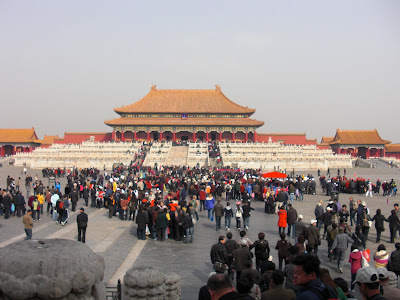
The Forbidden City is situated in the heart of the Beijing and was home to 24 emperors of the Ming and Qing Dynasties. In ancient times, the emperors claimed to be the sons of the heaven and their supreme power conferred upon them from the heavens. Their residence on the earth was built as a replica of the Purple Palace where the God lived in the Heaven. Such a divine place, forbidden for the ordinary people was called the Forbidden City. However, nowadays, visitors can get a glimpse of these residences and their surrounding abodes.

(The Forbidden City)

The Forbidden City houses treasures of Chinese cultural and historical relics, and is recognized as one of the most important five palaces in the world (the other four are the Palace of Versailles in France, the Buckingham Palace in the UK, the White House in the US and the Kremlin in Russia). The splendid architecture of the Forbidden City represents the essence and culmination of the traditional Chinese architectural accomplishment. In 1987, it was nominated as Cultural Heritage by UNESCO. It is the best preserved imperial palace in China and the largest ancient palatial structure in the world.

We traveled back through time as we walked through the City.

Reflexology herbal Medicine

Before proceeding on with the tour, we stopped at the old Olympic Stadium for a foot massage. The massage was not as good as the ones we frequent in Malaysia. We thought that we’d get a good reflexology session. We were disappointed.

The Royal Silk House

We stopped at a silk house and watched the ladies work the silkworm all the way to the finished products. The place was full with tourists and after a look see look see, we left for more interesting sights.

Hutong Rickshaw ride

A hutong is an ancient city alley or lane with quadrangle courtyard residences typical in Beijing. Surrounding the Forbidden City, many were built during the Yuan, Ming and Qing dynasties. In the prime of these dynasties the emperors, in order to establish supreme power for themselves, planned the city and arranged the residential areas according to the etiquette systems of the Zhou Dynasty. The centre of the city of Beijing was the royal palace -- the Forbidden City.

(the rickshaw ride)

One kind of hutongs, usually referred to as the regular hutong, was near the palace to the east and west and arranged in orderly fashion along the streets. Most of the residents of these hutongs were imperial kinsmen and aristocrats. Another kind, the simple and crude hutong, was mostly located far to the north and south of the palace. The residents were merchants and other ordinary people.

We took a rickshaw ride through a hutong filled with small criss crossing alleys. The ride wasn’t smooth due to major earthworks being done. The hutong we were in had been designated as protected heritage areas and conservation work was being done. It gave us a glimpse of the locals in their natural surroundings.

Acrobatic Troupe Show

After the trishaw ride, we relaxed at the Children’s Park. While waiting for the show, we saw men and women alike exercising in the park. It seems that exercising in various forms is a way of life for the Chinese here. Taichi, lion dancing and traditional dancing is a common street sight.

(A cultural and acrobatic show)

The show itself covered a large variety of acrobatics ending with more than 15 youths on a bicycle circling on stage. But the highlight was the face changing (Bianlian in Chinese) Bianlian was the fascinating part of the show. This is where two performers changed through half a dozen or more fearsome and brightly-coloured face masks seemingly by magic!

Day 3: 21 October 2009
The Great Wall of China

After about a 2hr drive north and two shopping stops at a jade and crystal factory, we had lunch at a Chinese Cloissone enamel factory. We watched them produce the enamelware. Cloisonne enamel is high-grade artwork. During the Jingtai period of the Ming Dynasty, it became popular. Handicraftsmen used the dark-blue enamel that gave the cloisonné the blue colour, hence it is called Jingtai blue, and is still used today.

(A walk on the Great Wall)

The making of cloisonné integrates bronze and porcelain-working skills, traditional painting and etching. It is the pinnacle of traditional Chinese handicraft. Cloisonne is also known as "inlaid enamel", which refers to the unique technique of the combination of porcelain and bronze. Lunch was good but the portions were huge. Fellow Malaysian travelers who crossed our paths agreed that while the food was good, the portions were impossible to finish. Our guide said that the Chinese ate large portions yet remained slim. Slimming Chinese tea must be their secret :)

The Great Wall of China, one of the greatest wonders of the world, was listed as a World Heritage by UNESCO in 1987. Just like a gigantic dragon, the Great Wall winds up and down across deserts, grasslands, mountains and plateaus, stretching approximately 5,600 km from east to west of China. With a history of more than 2000 years, some of the sections are now in ruins or have disappeared. However, it is still one of the most appealing attractions all around the world owing to its architectural grandeur and historical significance.

We walked, climbed, crawled and made it up the peak at the Badaling Great Wall situated in Yanqing County, over 70 km north of Beijing. It is the most well-preserved section of the Great Wall, built during the Ming Dynasty. This section has an average altitude of over 1,000 m and is the outpost of the Juyongguan Pass. The mountain slope is very steep and the roads are tortuous. These features made it a military stronghold. The Badaling Great Wall is like a strong dragon winding its way along the mountain ranges. And we successfully scaled this dragon :)

Masjids

We had the opportunity to visit the Nan Dou Ya Qing Zhen Si Mosque, serving the Hui community in the area.

(A pagoda shaped mosque)

Like most of the mosques in Beijing, Nan Dou Ya mosque is a combination of traditional Chinese architecture and Islamic art, with a series of pavilions and courtyard buildings and the Arabian characters and touches.

At the courtyard, we were surrounded by the courtyard chambers comprising the main prayer hall. It’s like being back in time!

After performing our prayers, we bought some sweet bepang like snacks outside the masjid. Our guide said that the snack was sold by the muslim chinese outside mosques only.

Wangfujing Street

(A shopping street)

On the way back to the hotel, we stopped at Wangfujing. It is now considered the central heart of the city. It is close to the Forbidden City. Wangfujing is a long shopping street! A walk from end to end would take about 30 minutes, and that's without looking at any shops. A major portion of Wangfujing consists of a pedestrian mall. It is comparable to most pedestrian malls worldwide. The street was full with local and international tourists. It reminded us of Vienna’s Stephenplatz. 'We had dinner and met with a couple of Malaysian visitors at another muslim restaurant before heading back to the hotel to rest after a full tiring day.

Day 4 :22 October 2009
The Yashow Market

As today has been designated a shopping day, we went to Yashow Market. Yashow is a paradise for bargain hunters in Beijing, a big draw for the tourist with some money to spend and some serious shopping to do too. It is located in the northeast of Beijing. Yashow is surrounded by the bars, restaurants and cafes of the Sanlitun area, the hottest eating and drinking area for tourists in the city.It's a 4 story building with shopping inside. The general quality of the goods here is not bad. The Yashow Market itself provides various articles of clothing a well as a lot of cashmere garments, down jackets, leather goods, shoes, hats, watches and some handicrafts and trinkets. It also has custom-fitted suits available. Good bargaining skills is a must to survive here. Our guide advised us to start at 30% from what was offered!

We people watched more than shopping :) We had a good seat across a shop selling wigs and hair stuff. Wigs must be cheap here because many western tourists were trying and buying them. Redheads became blondes instantaneously. One lady walked off buying a blue haired wig. Wonder when will she get to use it?

After a filling dinner which was largely unfinished, we headed back to the hotel.

The Bird’s Nest

As a last stop before returning home, we visited the Beijing 2008 Olympic Stadium. The spectacular Bird's Nest stadium, hailed as the finest arena in the world and the centre piece of the most expensive Olympics in history, is full of hidden symbolism.

(Beijing Olympic Stadium)

In Chinese mythology, the sun is represented by a circle and the moon by a square, reflected by the shape of the bird's nest and the Water Cube aquatic centre opposite, reinforced when the venues are lit at night, red for the Bird's Nest and blue for the Water Cube.

The shapes also echo the Chinese symbols for male and female, and are built either side of the north-south axis road which runs in a perfect straight line for three miles through Beijing, centered on the Forbidden City.

Designed by Swiss architects Herzog & de Meuron, the stadium has a revolutionary design, comprising an outer skeleton of 42,000 tons of steel, and an inner 'skin' of double-layered plastic which keeps out wind and rain and filters out UV light. It is designed to last for 100 years and withstand a force eight magnitude earthquake.

Upon arrival, we were greeted by hundreds of local and foreign tourists gathered between the Bird’s Nest and the Water Cube. It was the official opening ceremony of the Beijing International Tourism Festival. There were brightly colored floats with hundreds of colorful participants. Since we have a plane to catch, we couldn’t enjoy the whole event. We had lunch on the way to the airport.

The flight home was on time and we reached home just past midnight. It had been a perfect week break. What would be the next greatest wonder of the world to visit eh? Somewhere in the Middle East or South America kut?

Till then....

Sunday, 28 June 2009

Australia 2009: The starting point of a caravan holiday...

"The happiness of your life depends the quality of your thoughts..."

(Our reflections on the sand)

Australia Caravan Holiday
(13 -27 June 2009)

Our flight to Sydney departed 0900 and transited Sydney for 11/2 hours. It took another 2 hours to reach Brisbane. We arrived Brisbane International Airport at 2200. We booked a double room at Annie Shandon's Inn from the airport list and took a bus direct to the inn’s door step. It was a modest B&B hostel room with communal facilities, good enough for us to clean ourselves and had a good night rest. The weather was cool around 11C.

(Our camper van for two weeks)

Saturday, 27 June 2009

Australia 2009: 01 Moone Beach - Watching The Ocean Tide...

"Everything we hear is an opinion, not a fact. Everything we see is a perspective, not the truth..." - Marcus Aurelius

After a hearty breakfast, with Annie’s help, we managed to contact Apollo, a well-known campervan company, and booked us a caravan. With the campervan we can enjoy the freedom of a self drive escape that can take us anywhere. And there'll be a special offer of 10% discount if we stay at any of the Top Tourist Campsites. It cost us AUD 1,889 for 2 full weeks complete with comprehensive insurance coverage and GPS navigator. We headed for Coffs Harbor and stopped for provisions at an Asian Groceries Market.

(A beautiful day for the caravan drive)

We drove along the coast using the Pacific Highway, via Kemsey, Port Macquarie, Taree, passed a historical bridge crossing Clarence River. We saw our first kangaroo along the hi-way. A few kilometers ahead, we saw another one on its back with 4 legs pointing to the skies. Must have played too near the road and got knocked down by vehicles that passed by. We witnessed 2 accidents along the way too.

(A brief walk along the beach)

We reached Moonee Beach Camp site late and got into difficulties to get the caravan to power up and ended sleeping without a heater. Luckily the night was not that cold and we kept each other warm…

(A lone beach bird)

Friday, 26 June 2009

Australia 2009: 02 Coffs Harbour - The Big Banana...

"Fake riends believe in rumors. Real friends believe in you..."


(The Moone Beach)

From Moonee Beach Camp site we drove to Coffs Harbor Yacht Club to walk along the beautiful beach and have some photo shots. Coffs Harbour is the commercial and administrative centre of the Mid North Coast and is the major resort of the NSW North Coast. Coffs Harbour is popular with retirees and tourists.

(The Big Banana R&R)
'
It is also famous for its banana plantations, celebrated by 'The Big Banana' tourist destination. Apart from banana growing fishing is important here. The Jetty area of the city includes a marina, a large harbour with an accessible jetty, shops, restaurants and cafes, as well as the Muttonbird Island reserve, famous for its muttonbird population.
' '
(A whale-watching activity)

Coffs Harbour is a vibrant coastal city brimming with holiday fun. Between June to November, whale watching is Coff’s prime activity. We refueled and bought some provisions at the petrol station outside town. Lunch was fillet-o-fish at McD.

(A sail boat for rent)

We headed towards Sydney and stopped at Forsters Great Lake campsite for the night.

Thursday, 25 June 2009

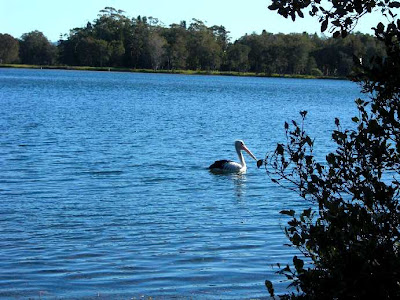
Australia 2009: 03 Forster - The Great Lakes lonely pelican...

"It is amazing what you can accomplish if you do not care who gets the credit..." - Harry S Truman

This morning we had cereal for breakfast. Lanis Great Lake campsite is located within peaceful natural surroundings where you get sunset and serenity absolutely free. As it was a working day, the campsite was quite empty except for long term tenants who stayed a week or more to enjoy the serene ambiance and wildlife of the Great Lakes.

(The Great Lakes)

The Great Lakes is only a 3 hour drive from Sydney but it seems a world away. The magnificent eastern dividing range forms a backdrop to one of the most dazzling stretches of coast. There are many things to do in the Great Lakes; there are amazing program of events including visiting stunning natural attractions and National Parks. If you are seeking relaxation or craving adrenalin fueled adventure - the Great Lakes is the perfect holiday destination to visit all year round, even in winter!

(A lonely pelican)

We circled the Great Lakes and headed towards Seal Rocks Camping Reserve, passing Booti Booti National Park and a few small beach towns with wide range of accommodations for visitors. Along the way we saw a few kangaroos merrily crossing our path.

(Black rocks on sandy beaches)

Seal Rocks is a fishing village and is accessible by a pleasant drive through Myall Lakes National Park. With great scuba diving, fabulous surf and beach fishing and clear turquoise water, Seal Rocks is an uncrowded natural paradise. One can stroll to the lighthouse and be rewarded with a panoramic view of the coastline. We expected to find a light house at end of the road at Seal Rocks but there was none in sight, most probably we need to access through another road. The spectacular sandy beach is beautifully surrounded by black rocks with stunning blowholes. The site is also famous for its dive with the sharks program and the 1992 whale rescue.

(A holiday camper park)

We drove on and stopped at Hexham for lunch. It was raining dogs and cats during the rest of the drive and the road was slippery. We saw an accident that caused a massive 24 km traffic jam. Our next stop for the night was the Sydney Hills Holiday Park situated at Dural, a suburb of Sydney.